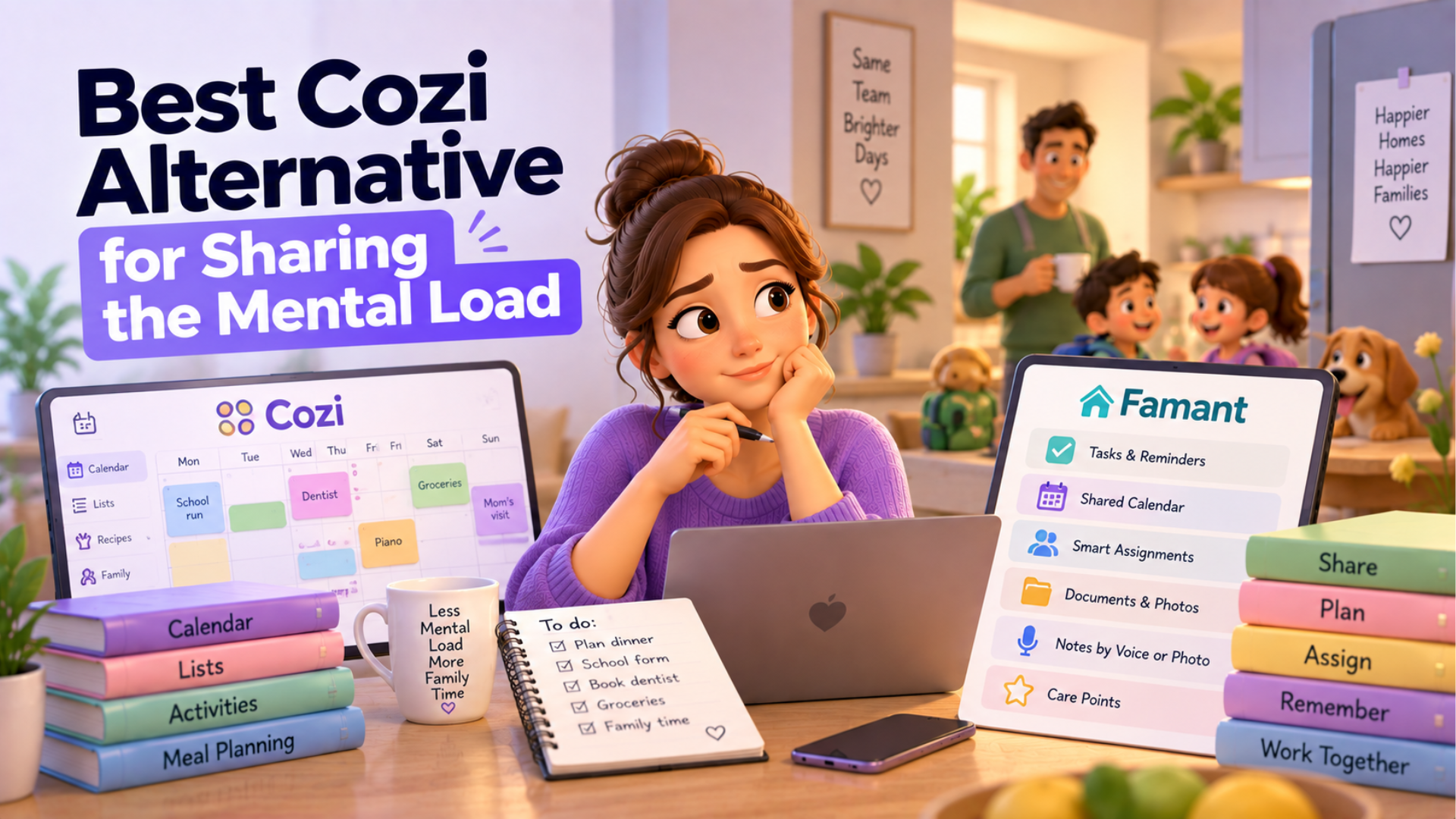
If you want a shared family calendar, Cozi does that well and has for years. People look for an alternative when the calendar is full and one person is still carrying everything the noticing, the planning, the remembering. That’s a different problem, and it needs a different kind of app.
Most “best alternative” articles open by explaining why the thing you’re using is bad. This one can’t, because Cozi isn’t.
It has been around for roughly two decades, it has hundreds of thousands of App Store ratings, and it does the job it was built for: putting a family’s schedule somewhere everyone can see it. If your household needs a shared calendar and lists, you could stop reading here and keep using it.
The reason people search for an alternative is usually more specific than Cozi is bad. It’s that the calendar is working perfectly and the household still isn’t.
What does Cozi do well?
It’s worth being clear about this, because it decides whether you need to switch at all.
Cozi is a family schedule in one place, colour-coded, shared with everyone, with lists alongside it. It’s mature, it’s widely used, and it handles the things families genuinely need from a calendar: who’s where, what’s when, what to buy. It’s particularly strong on the routine of a busy household, and a large share of what people use it for is children’s activity schedules.
If your problem is “we don’t know what’s happening this week,” Cozi solves that. Switching would be a downgrade.
So why do people look for an alternative?
Because a calendar answers when, and it has nothing to say about who carries it.
The usual sequence goes like this. The calendar gets set up. Everything goes in. For a fortnight it feels solved. Then the same person is still the one who noticed the appointment needed booking, put it in, set the reminder, and checked whether anyone read it. Nothing on the calendar is wrong. It’s just that the calendar records decisions after someone has made them and making them is the tiring part.
That’s the mental load: the noticing, planning and remembering that happens before anything reaches a calendar. A calendar is downstream of it.
The second thing people run into is that maintaining the calendar becomes its own job. If one person enters every event and chases everyone to check it, the tool has been added to their workload rather than taken from it.
The comparison that actually matters
Most comparisons count features, which is the wrong measurement for this decision and one Cozi would win, since it has had twenty years to accumulate them.
The useful question is narrower: does the app change who carries the household?
| Cozi | Famant | |
| Shared family schedule everyone can see | ✓ | ✓ |
| Shared lists | ✓ | ✓ |
| Children’s activity and sports schedules | ✓ | — |
| Recipes and meal planning | ✓ | — |
| Capture a thought before it’s sorted, by voice or photo | — | ✓ |
| Whole areas have a named owner, not just individual tasks | — | ✓ |
| Records who noticed and planned something, not only who did it | — | ✓ |
| Designed to work without one person maintaining it | — | ✓ |
| Ads | On the free tier — check current plans | No ads, ever |
Two rows there go to Cozi, and they’re not trivial: if sports schedules and recipes are what your family uses most, Cozi is the better tool and this is the wrong page for you.
The bottom four rows are the actual decision. They’re about whether the app moves the thinking, or just stores the outcome of it.
When Cozi is still the better choice
Genuinely, and this covers a lot of households:
● The calendar is the whole problem, and it’s working
● Children’s activity schedules are the bulk of what you track
● You want recipes and meal planning in the same place
● Nobody in the household feels like they’re carrying more than their share
● You’ve used it for years, everyone’s in the habit, and nothing is broken
An app only helps if it’s addressing the problem you actually have. If one person isn’t quietly running the household, a mental-load app solves a problem you don’t need to solve.
When Famant fits better
In practice, the difference shows up in four places.
You capture the thought, not the task. A thought arrives mid-drive or halfway through cooking the car’s due a service, the shoes have got small. Say it or photograph it, and it’s out of your head before it’s been sorted into a list, a date and an owner.
Areas have owners, not tasks. “You’ve got everything dentist-related” transfers the noticing along with the job. “Can you book the dentist?” doesn’t , you’re still the person who remembered it needed booking. That distinction is most of what separates a shared household from a busy one.
The planning gets recorded, not just the doing. Care Points mark who noticed something, planned around it and told everyone the half of the work that never shows up anywhere. Importantly, they are not a score: nobody is ranked, and there’s no leaderboard. If you’ve tried a chore app with points and found it made things worse, that’s the difference.
It isn’t built to need a manager. Reminders go to whoever owns the thing, so the app nudges you instead of you.
What it won’t do: replace Cozi’s sports schedules or recipes, and it won’t decide how your household divides responsibility. It makes that visible enough to divide.
What does switching actually involve?
More honestly than most pages on this subject: a couple of weeks.
Nothing imports a household’s habits. What you’re really moving isn’t data, it’s the arrangement who owns what. Before you switch anything, write that down in plain sentences: Sam owns the appointments. School admin is mine. Bins are Tuesday. That takes ten minutes and saves you renegotiating everything from scratch.
Then expect a fortnight of both of you actually using it before it settles. If you’re thinking about switching, don’t do it in December that’s the heaviest month for exactly the work you’re trying to share.
You can also run both for a while. Keep Cozi for the schedule, and use Famant for the part it doesn’t cover. Plenty of households do.
Frequently asked questions
Is there a free Cozi alternative?
Several family apps have free tiers, usually with ads or with the more useful features behind a paid plan. Check what a free tier actually includes before moving a household onto it switching twice in a year is worse than switching once.
Does Cozi help with the mental load?
Not directly. It’s a shared calendar and list app, so it holds decisions once they’ve been made. The mental load is the work of making them noticing, planning and remembering which happens before anything reaches a calendar.
Can I use Famant alongside Cozi?
Yes. If Cozi is working as your schedule, keep it and use Famant for the ownership and the invisible work. There’s no need to move everything at once.
What’s the main difference between Cozi and Famant?
Cozi shows a family what’s happening. Famant is built to change who carries it — whole areas get an owner, and the noticing and planning are recorded alongside the finished work.
Is Famant better than Cozi?
For a shared calendar, no Cozi is a mature, well-liked product with two decades behind it. For a household where one person is carrying the planning and remembering, Famant is built for that specific problem and Cozi isn’t.
The bottom line
If the question is “what’s happening this week?”, Cozi answers it, and has for years.
If the question is “why am I the only one who knows what’s happening this week?” that’s not a calendar problem, and no calendar will fix it.
Family life, a little lighter.
Leave a Reply