Tag: Home Management

  • Best Cozi Alternative for Sharing the Mental Load

    Best Cozi Alternative for Sharing the Mental Load

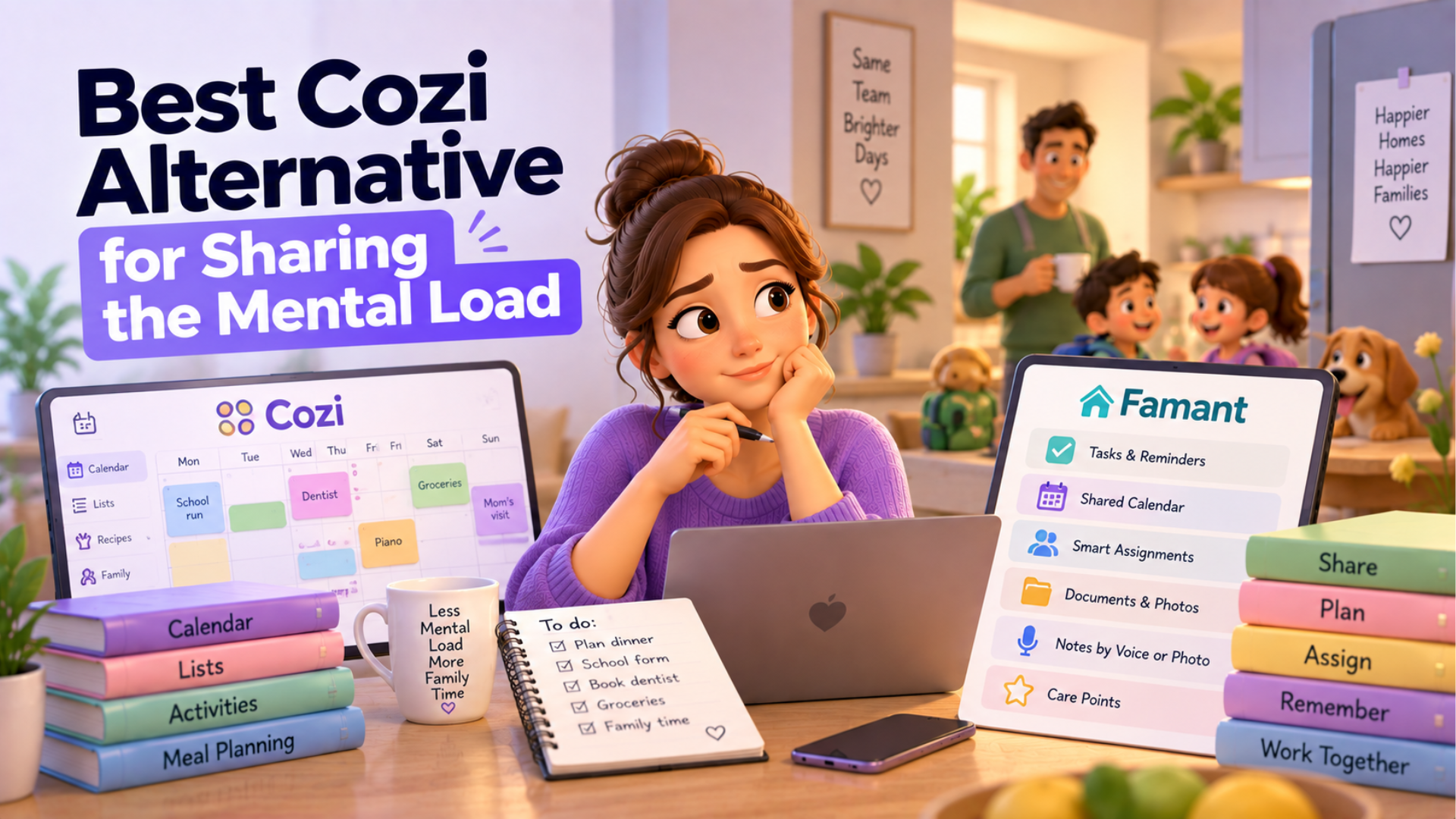
    If you want a shared family calendar, Cozi does that well and has for years. People look for an alternative when the calendar is full and one person is still carrying everything the noticing, the planning, the remembering. That’s a different problem, and it needs a different kind of app.

    Most “best alternative” articles open by explaining why the thing you’re using is bad. This one can’t, because Cozi isn’t.

    It has been around for roughly two decades, it has hundreds of thousands of App Store ratings, and it does the job it was built for: putting a family’s schedule somewhere everyone can see it. If your household needs a shared calendar and lists, you could stop reading here and keep using it.

    The reason people search for an alternative is usually more specific than Cozi is bad. It’s that the calendar is working perfectly and the household still isn’t.

    What does Cozi do well?

    It’s worth being clear about this, because it decides whether you need to switch at all.

    Cozi is a family schedule in one place, colour-coded, shared with everyone, with lists alongside it. It’s mature, it’s widely used, and it handles the things families genuinely need from a calendar: who’s where, what’s when, what to buy. It’s particularly strong on the routine of a busy household, and a large share of what people use it for is children’s activity schedules.

    If your problem is “we don’t know what’s happening this week,” Cozi solves that. Switching would be a downgrade.

    So why do people look for an alternative?

    Because a calendar answers when, and it has nothing to say about who carries it.

    The usual sequence goes like this. The calendar gets set up. Everything goes in. For a fortnight it feels solved. Then the same person is still the one who noticed the appointment needed booking, put it in, set the reminder, and checked whether anyone read it. Nothing on the calendar is wrong. It’s just that the calendar records decisions after someone has made them and making them is the tiring part.

    That’s the mental load: the noticing, planning and remembering that happens before anything reaches a calendar. A calendar is downstream of it.

    The second thing people run into is that maintaining the calendar becomes its own job. If one person enters every event and chases everyone to check it, the tool has been added to their workload rather than taken from it.

    The comparison that actually matters

    Most comparisons count features, which is the wrong measurement for this decision  and one Cozi would win, since it has had twenty years to accumulate them.

    The useful question is narrower: does the app change who carries the household?

     CoziFamant
    Shared family schedule everyone can see✓✓
    Shared lists✓✓
    Children’s activity and sports schedules✓—
    Recipes and meal planning✓—
    Capture a thought before it’s sorted, by voice or photo—✓
    Whole areas have a named owner, not just individual tasks—✓
    Records who noticed and planned something, not only who did it—✓
    Designed to work without one person maintaining it—✓
    AdsOn the free tier — check current plansNo ads, ever

    Two rows there go to Cozi, and they’re not trivial: if sports schedules and recipes are what your family uses most, Cozi is the better tool and this is the wrong page for you.

    The bottom four rows are the actual decision. They’re about whether the app moves the thinking, or just stores the outcome of it.

    When Cozi is still the better choice

    Genuinely, and this covers a lot of households:

    ●       The calendar is the whole problem, and it’s working

    ●       Children’s activity schedules are the bulk of what you track

    ●       You want recipes and meal planning in the same place

    ●       Nobody in the household feels like they’re carrying more than their share

    ●       You’ve used it for years, everyone’s in the habit, and nothing is broken

    An app only helps if it’s addressing the problem you actually have. If one person isn’t quietly running the household, a mental-load app solves a problem you don’t need to solve.

    When Famant fits better

    Famant is a family app made by Antutive AB in Gothenburg, Sweden. It makes the unseen work of family life visible and shares it fairly, using Care Points to recognise who noticed, planned and remembered.

    In practice, the difference shows up in four places.

    You capture the thought, not the task. A thought arrives mid-drive or halfway through cooking the car’s due a service, the shoes have got small. Say it or photograph it, and it’s out of your head before it’s been sorted into a list, a date and an owner.

    Areas have owners, not tasks. “You’ve got everything dentist-related” transfers the noticing along with the job. “Can you book the dentist?” doesn’t , you’re still the person who remembered it needed booking. That distinction is most of what separates a shared household from a busy one.

    The planning gets recorded, not just the doing. Care Points mark who noticed something, planned around it and told everyone the half of the work that never shows up anywhere. Importantly, they are not a score: nobody is ranked, and there’s no leaderboard. If you’ve tried a chore app with points and found it made things worse, that’s the difference.

    It isn’t built to need a manager. Reminders go to whoever owns the thing, so the app nudges you instead of you.

    What it won’t do: replace Cozi’s sports schedules or recipes, and it won’t decide how your household divides responsibility. It makes that visible enough to divide.

    What does switching actually involve?

    More honestly than most pages on this subject: a couple of weeks.

    Nothing imports a household’s habits. What you’re really moving isn’t data, it’s the arrangement  who owns what. Before you switch anything, write that down in plain sentences: Sam owns the appointments. School admin is mine. Bins are Tuesday. That takes ten minutes and saves you renegotiating everything from scratch.

    Then expect a fortnight of both of you actually using it before it settles. If you’re thinking about switching, don’t do it in December that’s the heaviest month for exactly the work you’re trying to share.

    You can also run both for a while. Keep Cozi for the schedule, and use Famant for the part it doesn’t cover. Plenty of households do.

    Frequently asked questions

    Is there a free Cozi alternative?

    Several family apps have free tiers, usually with ads or with the more useful features behind a paid plan. Check what a free tier actually includes before moving a household onto it switching twice in a year is worse than switching once.

    Does Cozi help with the mental load?

    Not directly. It’s a shared calendar and list app, so it holds decisions once they’ve been made. The mental load is the work of making them  noticing, planning and remembering which happens before anything reaches a calendar.

    Can I use Famant alongside Cozi?

    Yes. If Cozi is working as your schedule, keep it and use Famant for the ownership and the invisible work. There’s no need to move everything at once.

    What’s the main difference between Cozi and Famant?

    Cozi shows a family what’s happening. Famant is built to change who carries it — whole areas get an owner, and the noticing and planning are recorded alongside the finished work.

    Is Famant better than Cozi?

    For a shared calendar, no Cozi is a mature, well-liked product with two decades behind it. For a household where one person is carrying the planning and remembering, Famant is built for that specific problem and Cozi isn’t.

    The bottom line

    If the question is “what’s happening this week?”, Cozi answers it, and has for years.

    If the question is “why am I the only one who knows what’s happening this week?”  that’s not a calendar problem, and no calendar will fix it.

    Family life, a little lighter.

  • Why the More Flexible Partner Often Ends Up Doing More at Home

    Why the More Flexible Partner Often Ends Up Doing More at Home

    The more flexible partner often ends up handling more at home not because they have less work, but because their schedule looks easier to interrupt. School runs, appointments and errands seem like they can fit around a movable workday. Over time, flexibility quietly becomes availability, and availability becomes responsibility.

    The school rings because your daughter’s not well. Who can go? You can.

    The plumber needs access between nine and one. Who can be in? You can.

    Someone has to collect the prescription, return the parcel, sign the form, be there for the delivery. Who’s got more to give in their day? You have.

    No single one of those is unfair. Each one is just the practical answer. But when the practical answer is the same person forty times in a year, something has quietly changed and nobody chose it.

    Why does it always come back to the same person?

    Because one of you has a door that opens and the other doesn’t.

    A fixed-hours job settles the question before it’s asked. If your partner has to be somewhere between nine and five, they’re genuinely not available at eleven on a Tuesday and everyone, including them, knows it. Your day bends, so your day becomes the one that gets bent.

    Crucially, that says nothing about whose work is more demanding. Movable hours aren’t fewer hours. The deadlines, meetings and clients all still exist; they’ve just been pushed into the evening to make room for the appointment.

    The flexible partner becomes the household’s safety net

    This is the part that rarely gets named, and it’s the heaviest.

    Family life is mostly disruption. Someone’s ill, a meeting overruns, the bus doesn’t come, the school shuts, the appointment moves, the delivery fails, the form has to be in today. Every one of those needs somebody to absorb it at short notice and in a household with one flexible diary, there’s only ever one candidate.

    Being the safety net feels useful at first. You’re the reason things don’t fall apart. But absorbing disruption is work, and it has a specific cost: your plans are always the ones that move. Your afternoon gets rearranged. Your concentration goes. The gap you’d kept for your own work becomes the gap where the plumber happens. Over a year, you’re the only person in the house whose time is treated as provisional.

    And it’s rarely just the errand. Behind the appointment sits noticing it was due, finding a slot, booking it, remembering it, reshaping the rest of the day around it, telling everyone else and following up afterwards. A thirty-minute appointment can occupy someone’s head for a week.

    Does fair mean doing the same things?

    No, and insisting on it would be its own kind of silly.

    If one of you genuinely has more room in the day at this point in your lives, it can make complete sense for them to take some of the daytime running. The question isn’t whether the trips are split evenly. It’s whether the flexibility is being counted as part of the overall household load, or treated as free.

    Which is where it usually goes wrong. Taking the daytime appointments shouldn’t quietly also mean owning the remembering, the booking and the planning for every appointment in the family. If one person absorbs the daytime disruption, the other can reasonably own something whole in return the school communication, the maintenance, the meals end to end, including the noticing.

    The conversation worth having

    Not why did I have to do the pickup again today? That one turns into a tally, and tallies go nowhere.

    The better question is: how much of the household’s responsibility is currently being absorbed by my flexibility? That reframes it from a dispute about one afternoon into something you can both actually look at and it’s usually the moment the pattern becomes visible to the partner who hadn’t seen it, because they were never being asked to.

    It helps to look past the visible chores when you do. Who notices appointments are due? Who books them? Who handles the school? Who deals with whatever happens at eleven on a Tuesday? Who changes their working day when the family needs something? Two people can look like they share the house fairly while only one of them is continuously rearranging their work around everyone else.

    If it’s useful, there’s a fuller picture of how household load and working life pull on each other in our guide to work-life balance when you have a family.

    Where Famant helps

    Most of this happens because the decision gets made on the spot, by whoever’s free, rather than by what’s already been agreed.

    Famant keeps the household’s information and responsibilities in one place both of you can see. Smart assignment gives areas a named owner, so the answer to “who’s dealing with this?” isn’t decided each time by whose calendar looks emptiest. Load visibility shows where things have actually been landing over recent weeks, including the daytime interruptions that never appear on a chore list. And Care Points recognise the noticing and rearranging that make up a flexible day, used up without anyone registering it.

    It isn’t there to settle an argument. It’s so the pattern is visible before it’s a year old. Flexibility should be an option, not an obligation

    A flexible job can be one of the best things that happens to a family. It makes the unexpected survivable and lets people be there for things that matter.

    It works best when it stays a choice. You should be able to say I can take this one today without it silently becoming I’ll always take things like this. You should be able to work from home without becoming the person who runs the home. And you should be able to move your hours without having your whole week treated as movable.

    Family life, a little lighter.

  • How to Rebalance Household Responsibilities When Work Gets Busy

    How to Rebalance Household Responsibilities When Work Gets Busy

    When work gets busy, the household load doesn’t disappear. Someone still has to make appointments, manage school schedules, buy groceries, cook, clean, remember deadlines and deal with the unexpected. Rebalancing household responsibilities means adjusting who carries that work as capacity changes, rather than expecting the same person to keep absorbing everything.

    Every job has its periods. A deadline, a launch, a new project, a difficult client, exam season, a month where everything lands at once.

    What usually happens is that nothing at home changes at all. You work later and still sort dinner. You have twice the meetings and still remember the school form. You’re away for three days and still book the appointment from a hotel room. Your capacity has halved and the household is running exactly as it was.

    That’s how a perfectly ordinary busy fortnight turns into an unequal year.

    Ask who has capacity, not who normally does it

    The instinctive question is who usually handles this? and during a busy period it’s the wrong one, because it produces the same answer it always did.

    The more useful question is: who has the capacity to carry this right now? Those aren’t always the same person. Someone might normally do the shopping but be working every evening for a fortnight. Someone else might normally handle the school but have a quiet stretch coming up.

    You’re not rewriting who owns what permanently. You’re acknowledging that capacity moves, and that a responsibility which was easy three months ago might not be this month. Pretending otherwise doesn’t make the work vanish; it just pushes it onto whoever is already closest to the edge.

    Do it before the crunch, not after the collapse

    Most households only discuss this after someone hits a wall, at which point it arrives as I can’t do this anymore or why am I the only one thinking about anything? By then the place has been running beyond one person’s limit for weeks.

    The thing is, busy periods are usually visible in advance. If you know next month means late nights, travel or a deadline, that’s the moment to sit down  not because anything is going wrong, but because you can see what’s coming.

    Four questions cover it:

    • What has to happen regardless?
    • What can genuinely wait until this is over?
    • Which responsibilities move, and to whom?
    • When does this arrangement end?

    That last one matters more than it looks, for reasons that become clear below.

    It also heads off the specific misunderstanding this situation produces, where one person thinks I assumed you were handling it while the other thinks I thought you knew I couldn’t this week. Both entirely reasonable. Neither said out loud.

    Move responsibilities, not errands

    If your partner is flat out, taking one chore off them rarely helps much because the planning behind it is still theirs.

    Saying Send me a list of what needs doing sounds generous and leaves them doing the hardest part: noticing what’s needed, deciding what belongs on the list, explaining it, then checking it happened. They’ve handed over the doing and kept the managing.

    What actually lightens a busy fortnight is taking an area whole: I’ve got everything school-related until your launch is done the noticing, the dates, the supplies, the lot. That distinction between helping and owning is worth understanding properly, and it’s never more useful than during a crunch.

    Decide what simply doesn’t happen for a fortnight

    Rebalancing isn’t only about moving work between two people. Sometimes it’s about the household doing less.

    Busy periods often come with an unspoken insistence that every standard holds: the house stays as tidy, every meal gets cooked properly, every errand runs on schedule, the weekend stays useful. It doesn’t have to. The house can be messier for two weeks. Takeaway twice is fine. The garden can wait. A family commitment can be simplified or skipped.

    Deciding that together, out loud, is far better than one person quietly failing to meet a standard nobody ever agreed on.

    The trap most households miss: when temporary becomes permanent

    Here’s the failure mode nobody plans for, and it causes as much damage as never adjusting at all.

    One partner takes on more because the other is buried. The deadline passes. The busy period ends. And nobody changes anything back. Weeks become months. The person who stepped in is still doing the school run, still booking the appointments and at some point it stopped being help and became theirs, without a word being said.

    That breeds its own resentment, and a particularly awkward kind: they volunteered, so it feels petty to raise it. Meanwhile, the other person genuinely hasn’t noticed, because from where they’re standing nothing changed and it’s just been handled for a while.

    Which is why a temporary arrangement needs an end date at the start. When the crunch finishes, take ten minutes: what moved, what’s going back, and what should stay changed because it turns out it works better this way. The aim isn’t to restore the old arrangement exactly. It’s to make the new one deliberate rather than accidental.

    Talk about the whole picture, not yesterday

    These conversations slide easily into a tally. I cooked yesterday, I did the school run twice, I worked late three nights. Nobody wins that, and counting was never the useful part anyway.

    The more revealing questions are about the shape of each person’s week. Who’s been carrying the planning? Who’s getting uninterrupted time, and who’s being interrupted all day? Who can actually stop at the end of the day? Whose capacity is genuinely limited right now, and for how long?

    That’s also the underlying point of work-life balance when you have a family: paid work tends to be treated as the real workload that everything else fits around. But if one person is doing twelve-hour days, the family still needs feeding, the appointments still exist, and somebody is still carrying all of it. The pressure doesn’t disappear because work went up. It just moves usually invisibly.

    Where Famant helps

    Adjusting a load is much easier when both of you can see it.

    Famant keeps the household’s responsibilities and what’s coming up somewhere shared, so a busy week can be planned around rather than absorbed by whoever notices first. Smart assignment gives each area a named owner, which makes a temporary handover explicit and makes it obvious later what was only ever meant to be temporary. Load visibility shows where things have actually been landing over recent weeks, so a slow drift gets spotted while it’s still easy to fix. And if one person is genuinely swamped, Auto redistribution can shift things rather than leaving them to pile up.

    Liv offers the picture; the two of you decide what moves.

    A household that can adapt

    A fair division of work isn’t a contract signed once. Some weeks are calm, some are chaotic, and life keeps supplying deadlines, illnesses, school holidays and unexpected problems.

    What matters isn’t that every week is split evenly. It’s that when things get heavier for one person, the household notices and adjusts instead of one person quietly becoming the place all the extra weight goes.

    Family life, a little lighter.

  • How to Create an After-Work Boundary When You Have a Family

    How to Create an After-Work Boundary When You Have a Family

    An after-work boundary helps separate your job from family responsibilities, so that finishing work doesn’t immediately become the start of another shift. Set a clear stopping point, decide what genuinely needs attention, share household responsibilities, and protect some time when you’re not expected to work, plan, remember or organise.

    The laptop closes. Technically, the day is done.

    Then someone asks what’s for dinner. There’s a school message needing a reply. Something has to be ready for tomorrow. The washing needs putting away. An appointment needs booking. And your partner wants to know whether you’ve remembered the thing on Saturday.

    For a lot of people with families, this is the actual problem. Not the number of hours worked, but that there’s no gap at all between one set of responsibilities and the next. Work ends, household management begins, and somewhere underneath both, tomorrow’s work is still quietly running.

    A boundary helps. It just has to be more than shutting a laptop at five.

    Where does the boundary actually go?

    Not only between you and your job. Between you and the running of the house.

    Most advice about switching off assumes one line: work on one side, life on the other. With a family there are really two. You can close the laptop and go straight into three hours of logistics without ever reaching an evening – work, then family admin, then a bit more work once everyone’s in bed. The first line is easy to draw. It’s the second one that decides whether you get a break.

    Start with the simple half. Pick an end point : five, six, whatever your job allows and make it mean something: laptop shut, notifications off, away from the desk, not just one more thing. Some days won’t allow it, and that’s fine; the point isn’t a perfect record, it’s a recognisable signal that work is finished for now.

    Then give yourself a moment of transition, especially if there’s no commute doing that job for you. Change your clothes, walk round the block, make a cup of tea, sit with the children for ten minutes. It needn’t be long. It just needs to mark the difference between I’m working and I’m home, because without it, the two stay mixed all evening. (If work and home have blurred generally, that’s a bigger pattern worth looking at.)

    Don’t swap a work inbox for a household one

    This is the trap almost everyone falls into. You finally stop checking work email and spend the next three hours on school messages, class group chats, shopping lists, the family calendar and appointment reminders.

    Your working day is over. You’re still processing information, still making decisions, still holding everything in your head. From the neck up, very little has changed.

    It helps to separate genuine communication from household admin. Talking to your family isn’t the problem. Triaging the household’s paperwork all evening is. Not every message needs answering tonight, not every task needs solving before bed, and not every piece of information actually needs to pass through you at all.

    What really has to happen tonight?

    Evenings feel overwhelming partly because everything arrives with the same apparent urgency. Dinner, the laundry, the email, the form, the bathroom, tomorrow’s plan.

    Three questions usually cut it down fast:

    1. What genuinely has to happen before bed? Usually a much shorter list than it feels like.
    2. What can wait? Most of it. Tomorrow, the weekend, next week.
    3. What could someone else own? Not “help with”  own, from noticing through to done. That distinction is the whole difference between an evening that lightens and one that doesn’t.

    Run that filter and a second workday often shrinks into about forty minutes.

    Agree what “urgent” actually means

    Family life will interrupt you, and some of it genuinely should. A sick child is urgent. A real emergency is urgent.

    But plenty of things feel urgent purely because they’ve just arrived. If nobody has ever said out loud what counts, then by default everything does and it all lands on whoever is known for sorting things out.

    Deciding together what actually needs dealing with immediately is a small conversation with a disproportionate effect. If everyone knows the threshold, far fewer things automatically become yours by default.

    A boundary isn’t withdrawal

    This is the bit that stops people trying, so it’s worth saying plainly: protecting your evening doesn’t mean becoming unavailable to your family.

    Home isn’t an office. There’ll be spontaneous conversations, bedtime, someone needing you unexpectedly. The line you’re drawing isn’t between you and the people you live with. It’s between being present and being permanently responsible and you can absolutely be there for your family without being the one who remembers everything.

    One warning in the other direction, too. It’s easy to respond to all this by building an elaborate evening: exercise at six, dinner at seven, reading at eight, no screens after nine. That’s just another schedule to keep on top of. A boundary can be as simple as deciding that once work ends, you don’t owe anyone a well-used evening.

    Because that’s the quiet thing that happens when every hour has a job in it , rest starts to feel like something you have to earn first. You don’t. Sometimes the best possible use of an evening is just having one.

    Where Famant helps

    Most people can’t switch off for a specific reason: they’re the only copy of the household’s information. Letting go of a thought would mean losing it.

    That’s what capture is for. When something surfaces at half nine – book the car service, buy a present for Saturday . You say it out loud or photograph it, and Liv files it somewhere it won’t be lost. You’re not solving it tonight; you’re putting it down, which is the part your brain won’t do while it’s the only record.

    The rest follows from the same idea. A Shared calendar means people can see what’s coming rather than asking you. Smart assignment gives a task to an owner, so it isn’t waiting for you to notice it. Smart reminders reach whoever owns the thing, which means the chasing doesn’t have to come from you. And Care Points recognise the noticing and planning that fills these evenings in the first place.

    The aim isn’t a more organised household for its own sake. It’s less of the household living in one person’s head. Download famant

    Start with one line, not a new system

    You don’t need to redesign family life this week. Pick one boundary and see what it reveals.

    Work stops at a set time. Or notifications go off after dinner. Or household admin doesn’t happen after eight. Or one evening a week is protected. Or you hand over one recurring responsibility completely which may well need a conversation first.

    Some days will still go badly. Work will overrun, someone will be ill, plans will collapse. Balance was never about every day landing evenly; it’s about having enough shared responsibility that one difficult day doesn’t quietly become every day.

    An after-work boundary isn’t really a line between your laptop and your living room. It’s a line between what you’re responsible for and what you’re allowed to put down. When the household work is genuinely shared, that line gets much easier to hold and it doesn’t keep you away from the people you love. It gives you enough room to actually be with them.

    Family life, a little lighter.

  • Why You Can Have a Flexible Job and Still Have No Work-Life Balance

    Why You Can Have a Flexible Job and Still Have No Work-Life Balance

    A flexible job can make work-life balance easier, but flexibility doesn’t automatically create more free time. When work hours are flexible, household responsibilities can quietly expand into the gaps. If you’re always the person available for school runs, appointments, errands, planning and family needs, your flexibility can become another source of invisible work.

    On paper it reads like the answer to everything. Start earlier, finish later, work from home, move a meeting when something comes up, take an hour out for an appointment and make it up in the evening.

    Then you notice what’s actually happening with all that freedom. The plumber’s coming – you can be in. There’s an appointment at eleven- you can take them. School finishes early-  you can go. Dinner needs sorting – you can think about it over lunch.

    None of it is a burden on its own. But repeated across a few months, it adds up to something specific: your working day and your home life stop being separate things. You have flexibility. You don’t have balance.

    How does flexibility turn into responsibility?

    Through a small shift in wording that nobody says out loud. You can do it quietly becomes you should do it.

    It’s easiest to see when two people have different kinds of jobs. One works fixed hours somewhere else; the other works from home with some control over the day. A child is ill, the flexible one stays. An appointment comes up at eleven the flexible one takes it. A delivery needs signing for, the school rings, something overruns. Each time, the same person absorbs it, and each time it’s the sensible answer.

    Repeated often enough, sensible turns into structural. The flexible partner becomes the default for everything that doesn’t fit neatly into anyone else’s diary and at that point flexibility has stopped being freedom and started being a permanent state of being on call.

    Why isn’t a free hour actually free time?

    Because an unallocated hour and a genuinely free one are different things, and only one of them shows up on a calendar.

    You have forty minutes between meetings. In it you book an appointment, reply to a teacher, order school supplies, think about dinner and pay a bill. Nothing there appears on your work calendar, and none of it counts as a break. A morning can look like this:

    • 9am — work meeting
    • 9.45am — reply to a school message
    • 10am — back to a work task
    • 10.30am — book the dentist
    • 10.40am — work email
    • 11.15am — arrange a delivery
    • 11.30am — project meeting
    • 12.30pm — work out what everyone’s eating
    • 1pm — work
    • 2pm — sort out the pickup
    • 3pm — work

    Nothing on that list is difficult. What’s tiring is that your mind never gets a clean edge between the two worlds and you’re continuously remembering which things belong to which, and switching between them. You can end a day like that having done a full shift of each and feeling as though you concentrated on neither.

    When does the second shift actually start?

    Not at six o’clock, which is the traditional answer.

    The second shift usually describes the unpaid household work that begins once paid work ends. Flexible working dissolves that boundary almost completely. Your second shift might start at eleven in the morning. It might happen between two meetings, over lunch, in the minutes while a file uploads, or at half four before you’ve finished for the day.

    Household work no longer waits for you to be off the clock. It fills the spaces around paid work instead and because those spaces look flexible, they’re extremely easy to fill.

    Why does this cause resentment when nobody intended it?

    Because both people are being perfectly reasonable, and the arrangement is still wrong.

    The flexible partner starts to think: why am I responsible for everything that needs flexibility? The other one thinks: you’ve got more to give in your day, so why wouldn’t you? Neither is acting in bad faith. They’ve simply inherited an assumption that doesn’t hold up.

    The assumption is that flexibility equals spare capacity. It doesn’t. Having control over when you work isn’t the same as having less work to do, and being able to move things around isn’t the same as having energy left over. There’s a real difference between I can technically fit this in and I have the capacity to take responsibility for this  and almost all of the trouble lives in the gap between those two sentences.

    What actually helps?

    Not being less flexible. Flexibility is genuinely valuable to a family . The point is to stop defaulting into responsibility.

    1. Look at which areas keep landing on the flexible person. Appointments, school communication, deliveries, childcare, anything unexpected. Write them down. The pattern is usually obvious once it’s on paper.
    2. Ask who’s responsible, not who does it. Doing the task and owning it aren’t the same thing, and the imbalance normally shows up in the second question rather than the first. That distinction is the whole game.
    3. Divide by area, not by availability. One of you owns appointments; the other owns maintenance. One takes school communication; the other takes meals and groceries. Deliberately chosen — not assigned by whoever has the emptiest calendar.
    4. Stop treating every gap as available. Not every space in your day belongs to someone else, and not every household problem has to be dealt with the moment it appears. Some of them can wait until the evening, like they would if you were in an office.
    5. Give your own work an edge. Flexible work has a habit of expanding, starting early because the evening was hard, finishing late because the afternoon vanished, answering a few emails once everyone’s asleep. If work has no start and no end, neither does anything else.

    Where Famant helps

    Most of this happens because the household’s information lives in one person’s head usually the flexible one, because they’re the one who’s been handling it.

    Famant is built to move it out. The Shared calendar makes what’s coming up visible to everyone, so the flexible person isn’t the only one who knows an appointment exists. Smart assignment attaches an owner to a task rather than letting it drift to whoever is around. Smart reminders go to the person who owns the thing, which means the nudge stops having to come from you. And Care Points recognise the noticing and arranging the part that fills all those gaps between meetings and never appears on anyone’s calendar.

    The aim isn’t to run family life like a project. It’s to stop one person’s flexibility from standing in for everyone else’s visibility. Download famant.

    Flexibility should be the family’s, not one person’s

    A flexible job can be one of the best things to happen to a household. It makes pickups possible, appointments easier, commutes shorter, and the whole week less brittle.

    It works best when it’s treated as something the family has, rather than an unlimited supply of one person’s availability. You shouldn’t have to spend every flexible moment keeping the place running . There should still be hours where you’re simply off. Not working, not arranging, not remembering, not solving.

    Because real balance isn’t only having a job that fits around your life. It’s having a life that work and household responsibilities don’t quietly fill in every available space.

    Family life, a little lighter.

  • Does the Higher Earner Get a Lighter Load at Home?

    Does the Higher Earner Get a Lighter Load at Home?

    Not automatically. There’s a fair case for specialising when one job is genuinely inflexible, and income that pays for help does reduce the total load. But earnings measure market value, not effort, and the logic fits chores far better than the mental load, which carries on regardless of who does the task.

    It usually turns up late in the conversation, and it usually sounds like the end of it. I earn more. My job pays for most of this. Or the gentler version, which does the same work: I can’t just walk out at three.

    The awkward part is that it isn’t a stupid thing to say. There’s a real argument in there. It’s just that it answers a narrower question than the one being asked, and the gap between those two questions is where a lot of couples get stuck.

    Why does the argument sound so reasonable?

    Because for tasks, and for some jobs, it genuinely is.

    Economists have made a version of this case for decades: a household is a joint enterprise, and if an hour of one person’s paid work brings in more than an hour of the other’s, the household as a whole does better when that person spends more hours earning and less time on domestic work. Divide by strengths, and everyone gains. It isn’t a piece of self-serving logic invented mid-row; it’s a real position.

    There’s a practical version too, and anyone who’s tried to leave a hospital shift, a courtroom, or a trading desk at 2:45 knows it. Some jobs genuinely cannot absorb a call from the school. Pretending otherwise doesn’t make a household fairer; it just makes the plan fail on a Tuesday.

    And income does real work. Money that pays for a cleaner, a nursery place, a delivery slot or someone to do the garden doesn’t merely shift the load; it removes some of it altogether. That’s a genuine contribution to the household’s total burden, and it deserves to be counted.

    Held together, the case is: fairness means comparing total contribution, not insisting on a 50/50 split inside every category.

    So why doesn’t that settle it?

    Because hours and load aren’t the same thing, and earnings measure neither.

    A salary reflects what a market will pay for a skill. It doesn’t measure effort, tiredness, or how much of yourself a day takes. Two people can be equally spent at 9 pm having earned very different amounts that day, and the more tiring one isn’t reliably the better-paid one.

    Then there’s the shape of the work. Paid work has edges: a start, an end, a handover, colleagues who cover for you. The second shift has none of those. It doesn’t finish, nobody covers it, and it runs quietly in the background all day, which is precisely why it’s so often the real constraint on balance rather than the working hours themselves.

    And it compounds. Whoever takes the lighter paid load takes the heavier domestic one; that constrains their hours, their travel, and eventually their promotions; the earnings gap widens; and the widened gap now justifies the arrangement more strongly than before. Nobody sat down and chose that spiral. It’s just what happens when a sensible-sounding rule runs unattended for a few years.

    The case forThe case against
    Specialising by earnings raises total household incomeEarnings measure market value, not effort or fatigue
    Some jobs genuinely can’t absorb a 2 pm phone callFewer jobs are truly immovable than either partner assumes
    Higher income can buy help, removing work altogetherBought help still has to be found, booked, paid, and managed
    Fairness means comparing total contribution, not each categoryPaid work has an end; the second shift doesn’t
    Dividing by strengths is efficient for tasksThe mental load doesn’t transfer when a task does

    What is the argument usually really about?

    Rarely money. Almost always recognition.

    Listen to how it actually plays out, and both people are often saying the same thing in different currencies: I’m working hard, and it isn’t landing. The higher earner hears “you don’t do enough here” as a judgement on work they find genuinely demanding, and reaches for the one thing that’s easy to point at. The person carrying the household load hears “I earn more” as a ranking that what they do counts for less and has nothing equivalent to reach for at all.

    That asymmetry is the real trouble, and it isn’t anyone’s doing. Paid work comes with a receipt. It has a figure attached, a job title, a review at the end of the year, colleagues who can confirm it happened. The second shift has none of that. There’s no payslip for noticing the shoes have gotten too small, no appraisal for holding the diary of five people in your head. So one person can state their contribution and the other can only describe theirs, not because it’s smaller, but because nothing has ever counted it.

    Which is why these conversations go in circles. One side has a figure and the other has an account of their week, and a figure will win that exchange every time, not because it’s the stronger case, but because it’s the only one anybody wrote down.

    The distinction that usually resolves it

    Most of these arguments are two people answering different questions without noticing.

    Who does which jobs? is a scheduling question, and specialising by earnings and flexibility is a perfectly decent answer to it. Who carries the responsibility for noticing what needs doing? is something else entirely, and specialisation is a poor answer there, because it makes one person the sole holder of the household’s information. That’s the part with no off-switch, and it doesn’t transfer when a chore does. You can hand over the shopping and still be the only person who knows what’s needed.

    So: split the tasks by whatever logic fits your jobs. Just don’t let the same logic quietly assign all of the remembering to one person as well.

    How do you work it out in your own house?

    Not by settling who’s right. By getting the whole picture in front of both of you.

    1. Count the entire week, both columns. Paid hours, domestic hours, and on-duty time on evenings and weekends when someone is technically off but still the one who’d be interrupted. Most couples find at least one of those three lines surprising.
    2. Decide the doing and the noticing separately. Agree who does the task, then agree, out loud, who owns remembering it. They don’t have to be the same person, but the second one has to be someone.
    3. Test the inflexibility honestly, both ways. Which parts of each job genuinely can’t move? Usually it’s fewer than assumed on both sides.
    4. If income buys help, buy the thinking too. A cleaner still needs finding, booking, paying, and letting in. Outsourcing the task while keeping the management of it just relocates the load.
    5. Decide it, rather than drifting into it. An arrangement both of you have actually agreed is a completely different thing from one that assembled itself over four years.
    6. Put a date on revisiting it. New job, new baby, a move — the split silently reallocates and stays that way. Twice a year is enough. Sharing the household is a standing conversation, not a one-off settlement.

    Where a shared picture helps

    Most of these conversations stall because two people are comparing impressions rather than looking at the same thing.

    Famant is built to make the household side visible: Load visibility shows how the week actually fell, including the planning and remembering that never appear on a chore list, and Care Points give that invisible work its due recognition, recognising who noticed and organised something, not only who carried it out. Auto redistribution shifts things when one person is genuinely stretched, and Liv can flag an imbalance before it hardens into a pattern. Liv offers; the two of you decide.

    It isn’t there to prove a point, and it certainly isn’t a case file. It just means the discussion starts from one shared picture instead of two half-views. Join the waitlist, or read more about why balance is a load problem rather than a time problem.

    The better question

    “Does the higher earner get a lighter load?” doesn’t really have a general answer, and any piece that tells you it does is selling something.

    The more useful question is whether the arrangement you have was chosen or simply arrived at, and whether both of you would still describe it as fair if you swapped places tomorrow. Households run on all sorts of arrangements. The ones that hold up tend not to be the equal ones so much as the ones both people can say out loud without flinching.

    Family life, a little lighter.

  • The Future of Home Management: Why Every Family Needs a Household Operating System

    The Future of Home Management: Why Every Family Needs a Household Operating System

    It was supposed to be just a normal Tuesday morning.

    Emma had barely poured her first cup of coffee when the day started to fall apart. Her eight-year-old couldn’t find his school shoes. Her daughter suddenly remembered she needed chart paper for a science project at the last minute. A notification popped up reminding Emma of a dentist appointment she had forgotten to mention to her husband. Just as everyone hurried toward the front door, another email arrived from the school announcing a change in tomorrow’s pickup schedule due to a staff meeting.

    By the time the kids left, the kitchen looked like a war zone. But what truly wore Emma out wasn’t the mess , it was the endless mental to-do list running through her head.

    Buy chart paper.

    Reply to the teacher.

    Reschedule tomorrow’s meeting.

    Book Grandma’s health check-up.

    Order groceries.

    Remember that Liam’s football practice starts earlier this week.

    None of these tasks were written down or considered chores, yet together they drained more energy than washing dishes or folding laundry ever could.

    As she sat down to start her workday, Emma realized something unexpected: she hadn’t actually gotten much done yet, but she already felt mentally exhausted.

    That feeling wasn’t new. It had quietly become a regular part of her daily life.

    The Job Nobody Applies For

    Managing a household has transformed significantly over the past ten years.

    Nowadays, families are not just handling meals, laundry, and school runs. They are juggling hybrid work schedules, extracurricular activities, online school platforms, grocery deliveries, medical appointments, family finances, birthdays, vacations, and a constant flow of emails, messages, and notifications. Each day brings new information that must be remembered, understood, and acted upon.

    The difficulty is that much of this effort goes unnoticed.

    People see when someone prepares dinner or mows the lawn because those tasks have clear start and finish points. What often goes unrecognized is the mental effort beforehand. Someone realizes the pantry is nearly empty before anyone else does. Someone checks the family calendar before committing to dinner plans. Someone spots a conflict between soccer practice and a doctor’s appointment and quietly rearranges the afternoon without mentioning it.

    This ongoing mental effort is known as the mental load. Read the complete guide to understanding the mental load

    The mental load isn’t about doing more physical tasks. It involves bearing the responsibility of remembering, anticipating, organizing, and coordinating everything that keeps the family running smoothly. It resides in one person’s mind and often goes unnoticed until that person feels overwhelmed.

    Interestingly, the person carrying the mental load isn’t always the one doing the most chores. They are simply the one ensuring everyone else knows what needs to happen next.This unseen responsibility is what causes many parents to feel mentally drained before the day has even fully started.


    We Purchased More Apps. So Why Does Life Seem More Complicated?

    Technology was meant to simplify family life.

    Yet, many homes have turned into digital mosaics held together by routine.

    Appointments are kept in a calendar app. Grocery lists are saved elsewhere. School updates come via email, family chats happen on WhatsApp, reminders are stored on individual phones, and important documents get lost in folders no one recalls creating.

    Each app does its job adequately. The issue is that none of them sees the whole picture.

    Picture getting a school newsletter about a field trip. The email includes a deadline for permission slips, a payment date, a reminder to pack lunch, and a call for volunteers. The calendar notes the trip but doesn’t know about the permission slips. The shopping app isn’t aware that snacks need to be bought. The family chat turns into another place where reminders get buried under photos and weekend talk.

    None of the technology is faulty.

    The problem lies in the system.

    Rather than easing mental load, these disconnected tools quietly add to it because someone still has to piece everything together.

    Families haven’t become less organized.

    Their lives have simply outpaced the tools they rely on.

    Introducing Famant: Created for Families, Beyond Just Managing Tasks

    Here’s where Famant comes into play.

    Famant wasn’t developed because families needed another productivity tool. There are already numerous calendars, reminder apps, shopping lists, and task managers out there. The real issue wasn’t the shortage of tools, it was the lack of integration among them.

    Famant takes a unique approach to managing the home. Rather than viewing each duty as a separate item to check off, it sees the household as a dynamic system where information, communication, planning, and responsibilities seamlessly interact. Whether it’s a school notice, a grocery alert, or a change in weekend plans, Famant aims to minimize the mental effort families spend just to stay organized.

    The Three Foundations of a Household Operating System

    1. A Single Hub for Everything

    The first step to reducing disorder is to eliminate fragmentation. Rather than switching between multiple apps, Famant provides one reliable source of information for the whole family.

    For example, when a school newsletter arrives, usually someone must:

    ●      Read the email

    ●      Identify key dates

    ●      Add events to the calendar

    ●      Inform their partner

    ●      Set reminders

    ●      Remember needed supplies

    With a Household OS, information is entered once and automatically shared with everyone.

    No repetition.

    No missed messages.

    No constant forwarding.

    2. AI That Truly Lightens the Load

    While AI often promises increased productivity, Famant emphasizes something more important:

    Lowering mental effort.

    Its AI assistant, Liv, supports families by comprehending information rather than just storing it.

    For instance, Liv can:

    ●      Read long school newsletters

    ●      Highlight important deadlines

    ●      Extract event dates

    ●      Automatically add appointments

    ●      Generate preparation tasks

    ●      Organize duties

    Instead of sifting through pages of announcements, parents receive only the essential actions.

    This is automation that genuinely helps.

    3. Revealing the Hidden Work

    A major challenge in family life is that not all tasks look the same.

    Laundry might take thirty minutes. But planning meals for a week involves decision-making, budgeting, checking supplies, grocery shopping, and scheduling.

    Traditional to-do lists treat these tasks equally; Famant does not. Using its CarePoints system, the platform estimates both the time needed and the mental effort involved.

    The basic formula is:

    CarePoints = Base Execution Time × Friction Multiplier

    Famant’s CarePoints framework offers a unique perspective. It recognizes that household work involves more than just time spent. Activities like planning, coordinating, remembering, and anticipating also demand effort, even though they often go unnoticed. By highlighting these unseen contributions, CarePoints enable families to gain a clearer understanding of how tasks are truly divided not to assign blame, but to promote more balanced discussions and fairer collaboration.

    A Home Should Truly Feel Like Home

    Technology has changed how we work, communicate, shop, and travel. Yet, managing a household still largely relies on one person’s memory. We embrace digital innovation everywhere except in the place where most of our lives actually take place.

    Maybe that’s why many families feel like they’re always trying to catch up instead of moving ahead.

    The future of managing a home isn’t about adding another app or making another to-do list. It’s about creating systems that quietly eliminate unnecessary stress, so families can focus less on logistics and more on each other.

    Because at the end of the day, no one aspires to be the perfect household manager.

    They want to sit down for dinner without worrying about what they forgot.

    They want to enjoy a Saturday morning without mentally scheduling the entire week ahead.

    They want to be fully present with their loved ones.

    Perhaps the smartest homes of the future won’t be those packed with the most technology. Instead, they’ll be the ones where technology works so seamlessly in the background that families barely notice it.

    And maybe that’s the true promise of a Household Operating System not to help us manage our homes better, but to help us spend less time managing them and more time simply living in them.