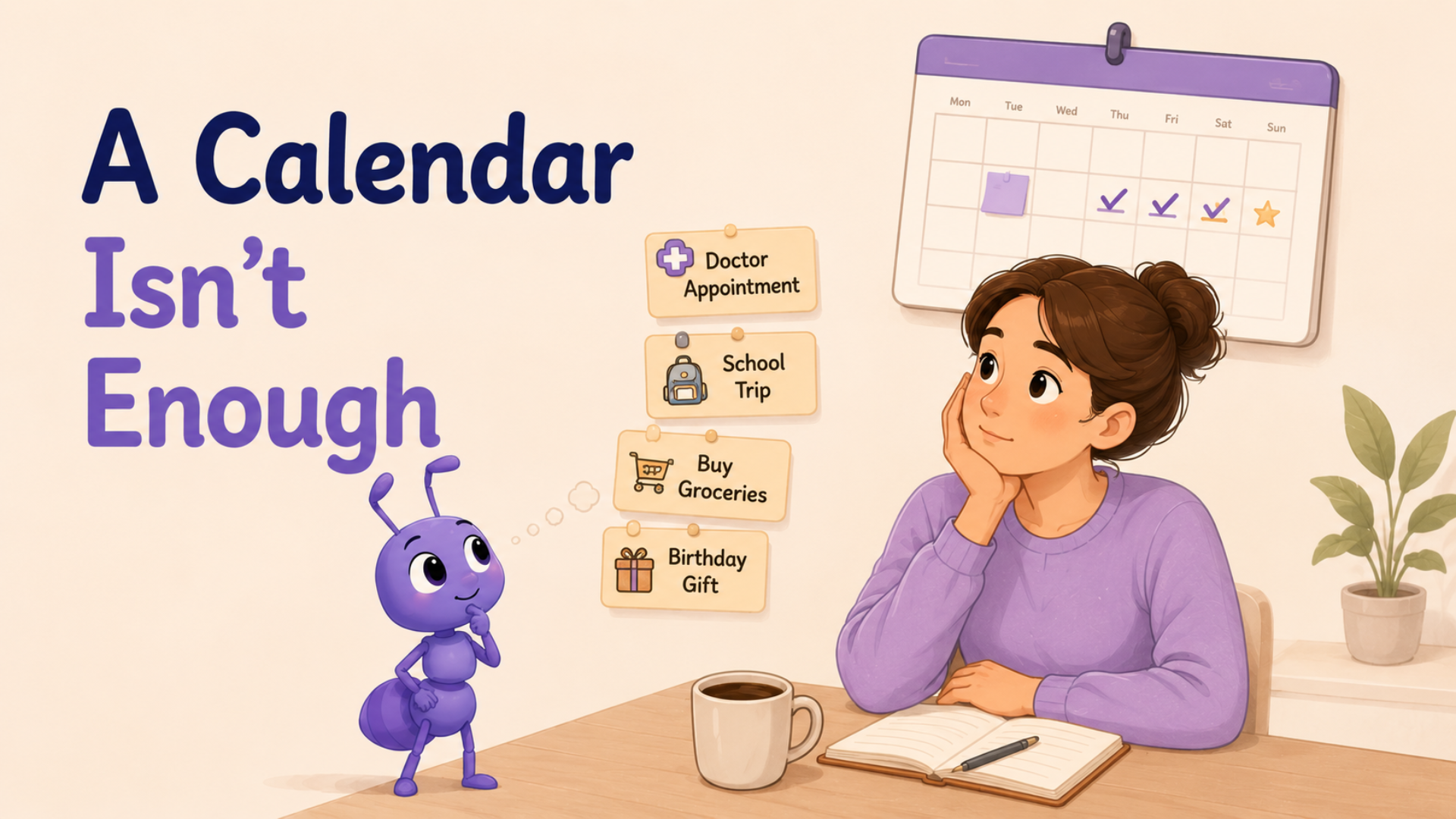
You can share a calendar in just five minutes. However, distributing the mental workload requires something that a calendar was never designed to handle.
It begins with good intentions. You set up a shared calendar, invite everyone, and birthdays, appointments, and school events all appear in one organized, color-coded place. For a week or two, it feels like you’ve finally figured out how to stay organized.
Then reality sets in. The permission slip remains unsigned. The dog food runs out. One partner assumes the other has taken care of groceries. A school email gets lost among numerous notifications. Eventually, someone says, “You never told me.”
Here’s the odd part: the information was available all along, right there on the shared calendar. So why did things still fall through the cracks?
Because a calendar only shows when something is scheduled. Managing a household requires much more than just remembering dates.
What’s the difference between a shared calendar and a family organiser app?
A shared calendar informs your family about when events occur. A family organization app goes further — it helps everyone understand what tasks need to be done, who is responsible, and how daily household duties are managed. It combines schedules, tasks, reminders, notes, documents, and shared responsibilities in one place, making family life easier to coordinate without relying on one person to remember everything.
It boils down to one question: is your household just tracking dates, or is it managing life?
What a shared calendar does well
Let’s give calendars their due credit. They solve one key problem better than most tools: visibility. Everyone can see when soccer practice starts, when Grandma’s birthday is, and which weekends are already booked. Reminders are set, events are color-coded, and scheduling conflicts are avoided.
Popular tools like Google Calendar and Apple Calendar are widely used for good reasons. If your family only needed to keep track of appointments and events, you wouldn’t need anything else.
But families usually don’t struggle because they forgot a birthday. They struggle because life involves hundreds of small responsibilities that never get added to the calendar in the first place.
When a Shared Calendar Isn’t Enough
Consider all the little things that keep a household functioning. Someone notices the milk is nearly finished. Someone else remembers the school project deadline is Tuesday, the insurance renewal is coming up next month, and there are only two dishwasher tablets left. Someone realizes the recycling needs to be taken out tonight.
Most of these tasks don’t fit neatly on a calendar yet they make up the mental burden of managing a home. Calendars weren’t designed to answer the most important questions:
- Who is responsible for this?
- Has it already been done?
- Is anyone overwhelmed this week?
- What still needs attention?
As a result, one person often ends up carrying all this information mentally, creating events, setting reminders, assigning tasks, and following up to ensure nothing is missed. The calendar quietly becomes just another thing to manage instead of truly easing the workload. Read the complete guide to understanding the mental load
How a Family Organiser App Helps
A family Organiser app is built on a different understanding: homes don’t run solely on schedules. They rely on communication, coordination, and shared responsibility.
Importantly, it fits into real life where information rarely comes as a neat, pre-organized task. For example, with Famant, you don’t need to organize your thoughts before capturing them:
- Remember mid-drive that the washing machine needs servicing? Just say it aloud.
- Receive a paper notice from school? Snap a photo.
- Need to keep track of an insurance renewal? Type a quick note.
Famant captures details as they arise and files them appropriately. This means fewer sticky notes, fewer missed messages, and fewer reminders running through your mind all day. All the everyday coordination a calendar wasn’t made to handle.
The Key Difference: Making Hidden Work Visible
The most important change isn’t really about technology , it’s about visibility.
In many households, one person quietly becomes the family’s memory. They know what’s in the fridge, keep track of appointments, remember birthdays, and remind everyone else. The problem is that this work is invisible to others, so it never gets shared.
A family Organiser app makes this hidden work visible. Everyone can see what’s going on, what still needs to be done, and who is responsible. Instead of repeatedly asking “What should I do?”, family members can simply check the app.
This shift turns delegation into shared ownership and that’s often where the greatest relief comes from. A shared calendar shows everyone’s schedules but can’t reveal if one person is silently managing everything behind the scenes. Sharing the planning and thinking that happens before the chores is what truly balances a household not by adding more tasks, but by distributing the invisible workload more fairly.
Shared Calendar vs. Family Organization App, Side by Side
Here’s how the two compare — not on features for their own sake, but on how much each one takes off your plate.
| What it does | Shared Calendar | Famant |
| Shows appointments and events | ✓ | ✓ |
| Keeps the family schedule in one place | ✓ | ✓ |
| Tracks everyday household tasks | Limited | ✓ |
| Assigns clear ownership, so nothing falls between people | — | ✓ |
| Makes the invisible mental load visible | — | ✓ |
| Helps balance responsibilities across the family | — | ✓ |
A calendar tells you when. A family organization app makes sure no single person is the only one who knows.
A Home Shouldn’t Rely on Just One Person to Remember Everything
No family plans to become disorganized—life simply gets hectic. The real difficulty isn’t just recalling one important date; it’s managing the countless small details that quietly accumulate every week.
If you’ve ever thought, “I thought someone else was taking care of that,” or noticed that one person always seems to remember everything, you’re not alone. Starting with a shared calendar is helpful. But if you want to go beyond just tracking dates and truly share the mental effort of running a household, it might be time for a solution designed for how families really live.
Famant helps everyone stay coordinated by capturing those little details before they slip away, making responsibilities clear, and encouraging the whole family to contribute. Because a home shouldn’t depend on one person’s memory—it should be a team effort.
Ready to lighten the load instead of carrying it alone? Try Famant.