Tag: mental load

  • Why Asking “Can You Do This?” Doesn’t Solve the Mental Load

    Why Asking “Can You Do This?” Doesn’t Solve the Mental Load

    Asking someone “Can you do this?” may share a task, but it doesn’t necessarily share the mental load. If one person still has to notice what needs doing, remember it, decide who should do it, ask for help, and follow up, they are still carrying most of the responsibility.

    It sounds like a perfectly reasonable question. The dentist needs to be booked, the bins need to go out, the car needs servicing, and a birthday present needs to be bought. So you ask your partner to take one of them on, they say yes, and they do it.

    Problem solved. Except that a week later you’re doing the same thing again, with a different task, and something about it is starting to grate.

    The reason is that there’s a difference between doing something and owning it, and almost the whole of the mental load lives in that gap. The mental load isn’t the booking; it’s noticing the appointment is due, working out when it should happen, deciding who’s making the call, and then remembering to check it got made. The call itself takes five minutes. The thinking around it runs for a fortnight.

    What actually gets shared when you ask?

    Less than it looks like, usually.

    Take a real example. The school sends a message saying your child needs sports kit by Friday. You read it. You register the date. You work out what’s needed, check whether you already own it, and realise something has to be bought. Then you ask: can you pick this up on the way home? And they do.

    From the outside, that task was shared. But run back through the chain and it’s clear who carried it. You noticed. You interpreted. You decided what had to happen and when. You assigned it. Your partner completed the last step of a job you’d already done nine-tenths of.

    That’s genuinely useful help. It just isn’t shared ownership, and the difference is the reason one person can feel supported and overloaded at the same time.

    Why do both people feel like they’re right?

    Because they usually both are, and that’s what makes the conversation so difficult.

    One person says I do loads around the house, and they’re not wrong. They might cook, do the school run, clean the kitchen, handle the shopping. The other says But I have to ask you to do everything and they’re not wrong either. Both statements can be entirely true at once, because they’re describing different jobs.

    The question isn’t how many tasks each person completes. It’s who’s keeping track of the whole thing. If one person has to work out what needs doing and then hand it out, they’re still running the household, whatever the split of physical work looks like. They’ve become the manager and nobody wants their home to feel like a standing meeting.

    What’s hidden behind a single task?

    A task rarely begins at the moment someone does it. Behind a doctor’s appointment sits a chain that looks something like this:

    1. Remember the appointment is due
    2. Know who needs it
    3. Find a suitable time
    4. Check it against everyone’s schedule
    5. Book it
    6. Put it in the calendar
    7. Sort transport if it’s needed
    8. Remember it on the day
    9. Make sure everyone else knows

    The visible task is “go to the doctor.” The other eight steps are the mental load. So when you ask whether you can take care of the appointment, you’ve only really shared it if the other person picks up the whole chain. If you’re still holding steps one, six and eight, almost nothing has moved.

    Why does the asking itself get so tiring?

    Can you book the appointment? Can you put that in the calendar? Can you remember the school trip? Can you pick up the present? Can you check that bill?

    Sooner or later the thought arrives: why am I the one who has to keep asking?

    That’s usually where the resentment starts, and it’s worth being precise about its cause. It isn’t that the other person won’t help; very often they help willingly, every time. It’s that one person has become permanently responsible for seeing the work in the first place, and every request is a small reminder of it.

    The same is true of the well-meant version: just tell me what you need me to do. It sounds like an offer of partnership, and it leaves you noticing, deciding, explaining, assigning, and following up the whole job apart from the last step. That one deserves a proper look on its own.

    In families with children, this hardens into something recognisable. One parent simply knows when the school holidays start, what goes in the bag, when the next vaccination is due, which forms need signing. The other helps readily whenever asked. But if only one of them ever knows, they stay the default organiser not because the other doesn’t care, but because the household’s information never actually got distributed.

    What does shared responsibility look like instead?

    It looks like someone owning an area from beginning to end.

    Rather than can you book the dentist?, the arrangement becomes: you own the children’s dental appointments. That means noticing when one is due, booking it, putting it in the shared calendar, telling anyone who needs to know, and making sure it happens. You don’t remember it for them. You don’t ask whether it’s been done. You don’t remind them.

    Practically, this is mostly a change in the question you ask:

    Instead ofTry
    “Can you remember to book the appointment?”“Who’s taking appointments this month?”
    “Can you pick up the school supplies?”“Who’s keeping track of school supplies?”
    “Can you remind me about the birthday?”“Who’s making sure the birthday is sorted?”
    “Can you put that in the calendar?”“Who owns the calendar for this?”

    The question moves from who can help? to who owns this?  and that small change in wording turns out to be most of the work.

    This isn’t about keeping score

    There’s an obvious wrong turn here, and it’s worth naming: households where responsibility becomes a tally. You did three things, I did five. I cooked, so you clean. I did the last nappy.

    That isn’t the kind of fairness most families actually want, and it tends to make things worse rather than better. Some weeks one person will do more. Circumstances change, someone gets ill, work gets busy, and the balance shifts as it should.

    The aim isn’t an equal day. It’s enough visibility that when the load quietly settles on the same person month after month, somebody notices and it gets adjusted.

    Where Famant helps

    Most of this comes down to one thing: you can’t share responsibility that only exists in one person’s head.

    Famant is built to get it out into the open. Smart assignment attaches an owner to a task rather than leaving it floating, so there’s a dentist appointment due also answers who’s handling it. The Shared calendar and Shared family feed mean the information doesn’t have to be relayed by hand, and Smart reminders reach the person who owns the job, so the nudge comes from the app instead of from you.

    Care Points do the part this article has been circling: they recognise the noticing, planning and organising, not just the finished task, which is precisely the work that goes unseen when someone says “but I do loads around the house.” And they’re built to do it without scorekeeping or blame, because a tally was never the point. Liv offers the picture; the family decides. Join the waitlist, or read more about handing things over without ending up managing them.

    A test worth running

    Here’s a simple one. If you stopped reminding everybody for a fortnight, would the household still work?

    If the answer is no, the load hasn’t really moved yet, however much everyone is helping. And if the answer is yes, something quietly valuable comes with it: you can stop holding it. Your partner knows what they own, knows where to find what they need, and can see what’s coming. You get to trust that someone else has it, and that trust is usually the first thing to go when the load gets uneven, and the best thing to get back.

    The goal was never for one person to get better at asking for help. It’s a home where help isn’t the arrangement in the first place.

    Family life, a little lighter.

  • Why Family Communication Breaks Down When One Person Carries the Mental Load

    Why Family Communication Breaks Down When One Person Carries the Mental Load

    Family communication often breaks down when one person carries most of the mental load, because they become the one who remembers, plans, notices, follows up, and keeps everyone informed. The problem isn’t a lack of communication. It’s that too much of the household’s information and responsibility lives in one person’s head.

    Did you book the appointment? Are we out of milk? What time is football practice? Did you send that form back? Who’s picking them up?

    There is no shortage of communication in that house. People are talking all day. And things still get missed.

    That’s usually what’s happening when one person has quietly become the household’s organiser. They know what’s coming up, they remember what needs doing, they notice what’s been forgotten, and they keep track of the school messages, the appointments, the birthdays, the bills. Eventually, keeping everyone else informed becomes one more thing on their list — and that’s where it starts to go wrong.

    First, a distinction worth making

    The mental load isn’t the doing. It’s the thinking that comes before it: noticing, planning, remembering that something needs doing at all.

    Someone takes the bin out when they’re asked. Someone else noticed it was full, remembered which day the collection is, and did the asking. Both people did something. Only one of them was keeping track. That gap is where most family communication problems actually live, and it’s why a household can look like it’s sharing the work while one person still feels responsible for nearly all of it.

    Why doesn’t talking more fix it?

    Because the trouble usually isn’t the amount of communication. It’s the shape of it.

    When most of the load sits with one person, they become the household’s information hub. Everyone knows who to ask, so everyone asks them. Where’s the appointment? What time is practice? Did we get the school supplies? When’s that bill due? The answers all live in one person’s head, phone, or notebook.

    At first this seems sensible. If someone is already keeping track of everything, asking them is the quickest route to an answer. But over time it produces a lopsided arrangement: one person has to receive information, make sense of it, remember it, and pass it on, while everyone else simply has to ask. That isn’t shared communication. It’s information dependency, and the person in the middle is the bottleneck whether they want to be or not.

    Why does communicating become so tiring?

    Because you’re not just passing on information. You’re remembering that it needs passing on.

    Think about what one school message actually costs. Someone reads it. Registers the date. Works out whether their child needs anything. Spots that a form needs signing. Tells their partner. Reminds them to sign it. Adds the date to the calendar. Then reminds everyone again the day before.

    No single step there is difficult. Together they form a chain of invisible work, repeated several times a week, and the person carrying it ends up feeling like they’re managing everyone else’s awareness on top of their own. That’s the point at which ordinary family communication stops feeling like talking and starts feeling like a job. Read the complete guide to understanding the Family communication

    Why doesn’t “I told you” settle anything?

    Because telling someone about a thing and handing them responsibility for it are different acts.

    Most household disagreements that look like communication failures I told you about that. I didn’t know you were expecting me to do it. I thought you were handling it are really about ownership being unclear. Nobody was being careless. The information moved, and the responsibility didn’t.

    “There’s a parent meeting on Thursday” is information. It leaves every useful question open:

    • Who’s going?
    • Who’s sorting childcare?
    • Who’s putting it in the calendar?
    • Who’s checking the time?
    • Who’s remembering it on the day?

    Left unanswered, those questions don’t disappear. They fall to whoever usually catches things, which is the same person, again.

    What about “just tell me what needs doing”?

    It’s meant generously, and it leaves the load exactly where it was.

    If one person still has to notice the task, decide what’s needed, explain it, hand it over, and check it happened, they’re managing the work while someone else completes it. Those aren’t the same job. Real sharing means both people can see what needs attention and take it on without waiting to be told, which is a whole subject of its own, and worth getting right.

    What does better family communication actually look like?

    Less like more conversations, and more like fewer things living in one person’s head.

    In practice, it usually means one shared place for family plans, appointments visible to everyone who needs them, reminders that reach people directly, and responsibility that’s assigned rather than mentioned in passing. The aim isn’t to track every detail of family life. It’s to reduce the number of things that only exist in one person’s memory.

    You can hear the difference in how a household talks. Ask Mum, she’ll know becomes we can all see it. Did you remind your dad? becomes it’s already on the shared plan. Tell me what you need me to do becomes I know what I’m responsible for.

    That sounds like a small shift in wording. It’s actually a change in what each person is for: one of them stops being the household’s memory, and everyone else stops needing to be told.

    Where Famant fits

    Famant is built for exactly this gap: not to add another channel, but to stop one person being the channel.

    The Shared family feed keeps plans, dates, and messages somewhere the whole household can see, so information doesn’t have to be relayed by hand. Real-time updates mean everyone finds out at the same time. Smart assignment attaches a name to a task, so “there’s a parent meeting on Thursday” also answers who’s going. And Smart reminders arrive from the app rather than from the person who’d otherwise be chasing.

    Underneath that, Liv listens, understands, and suggests sorting what you capture and proposing who might take it on, while Care Points give the noticing and organising their due, not just the finished jobs. Liv offers; the family decides. Join the waitlist.

    Communication should take work off someone, not add it

    Families will still forget things. Plans will change, messages will go unread. That isn’t the problem worth solving.

    The difference is whether the whole household depends on one person catching every gap. When information and responsibility are genuinely shared, there’s less chasing, less explaining, less reminding, and fewer of the arguments that were never really about the thing itself.

    So the more useful question isn’t: how do we communicate better? It’s how do we stop one person having to manage everyone else’s communication? That’s the shift from private knowledge to shared visibility, and from one person holding the household’s memory to the household holding it together.

    Family life, a little lighter.

  • Why Don’t Weekends Feel Like a Break?

    Why Don’t Weekends Feel Like a Break?

    Time off isn’t the same as being off duty. Recovery research finds that what restores people is psychological detachment mentally disengaging- not just stopping the tasks. If home is where your second shift happens, the weekend removes the work but not the responsibility, so the mind never quite clocks off.

    It’s Sunday, around seven. Tomorrow’s uniform is out, the washing machine is on its second load, and someone has just asked what’s for dinner. You’ve had two full days away from your job, and if anyone asked what you did with them, you’d struggle to name a single thing that was actually for you.

    It’s a strange sort of tiredness. You weren’t at work, so on paper you shouldn’t be tired, and yet Monday feels less like a fresh start than a continuation. Plenty of people quietly assume that means something’s wrong with them. Usually it means something much simpler, and much more fixable.

    Why doesn’t time off actually restore you?

    Because stopping the work and switching off from it are two different things, and only the second one restores you.

    Researchers who study how people recover from work have a name for it: psychological detachment. Sabine Sonnentag and Charlotte Fritz identified it as one of four recovery experiences, alongside relaxation, control, and mastery, and it’s the one that turns up most consistently in the findings on wellbeing. The important part is what it isn’t. Detachment doesn’t mean refraining from tasks; it means mentally disengaging, genuinely not thinking about it. You can sit perfectly still for an hour and get almost nothing back if your mind is still running the list.

    Which is the whole problem for whoever carries the household load, because for them, home is the workplace. Everyone else leaves the job and comes home to recover. They come home to the other job. There is no location, and no hour, in which the thing they’re responsible for isn’t right there in front of them, usually in the form of a laundry pile in the eyeline.

    That’s the difference between being off duty and being unoccupied. You can be unoccupied all Saturday afternoon and still be the person who’d be interrupted, the one who’d be asked, the one who’d notice. Standby isn’t rest. It just looks like it from the outside.

    Why is the weekend often busier than the week?

    Because weekdays run on rails, and Saturday doesn’t.

    Monday to Friday has a structure holding it up: school starts at the same time, work fills the middle, the evening routine more or less runs itself. Take that scaffolding away and every hour needs a decision. What are we doing, who’s taking whom, are we seeing anyone, what’s for lunch, does anyone need anything for Monday? The weekend is quietly the most decision-heavy part of the week, and decisions are exactly the thing that tires the person making them.

    Then there’s the queue. Everything that wouldn’t fit into a working week the appointment, the form, the birthday present, the big shop gets pushed to Saturday. The weekend was never empty. It’s the overflow buffer for the five days before it, and it was full before it began.

    And even the nice parts can count as work. Researchers distinguish between low-duty and high-duty leisure: low-duty activities support recovery, while high-duty ones work against most of it. A family day out is low-duty leisure for everyone who turns up to it and high-duty for the person who planned it, packed for it, and is keeping an eye on everyone throughout. Same outing. One person had a day off; another ran an event.

    Don’t the evenings help?

    Not usually, because the evening isn’t recovery time; it’s the second shift.

    Between about six and nine, the household work happens: the food, the bedtime, the tidying, the next day’s preparation. What’s left afterwards is often a short window at the end, by which point most people are too flattened to do anything restorative with it. And that window frequently gets spent on admin the forms, the bookings, the replies- which is why so much of the household’s paperwork mysteriously happens after ten at night.

    An evening spent finishing the day’s work isn’t a break. It’s the gap between two shifts.

    So why doesn’t “take some time for yourself” fix it?

    Because the load follows you into the bath.

    It’s well-meant advice, and it treats the problem as a shortage of hours. But if the reason you can’t switch off is that you’re the only person holding the household’s information, then handing you a free hour doesn’t produce detachment it produces an hour of thinking about the list somewhere quieter. Free time and off-duty time aren’t the same currency.

    There’s a cruel wrinkle here that the research names directly: the recovery paradox. Recovery processes tend to be impaired precisely when demands are highest, meaning the more you need to switch off, the harder switching off becomes. If you’ve ever had a free evening and found yourself unable to enjoy it, that isn’t a personal failing. It’s the most predictable finding in the field.

    What actually helps?

    Less than you’d think, but it has to be the right thing — aimed at the duty, not the tasks.

    1. Hand over the duty, not just the jobs. Name the person who gets interrupted for a defined block: from two until five, they ask you, not me. This is the one that matters most, because it targets standby rather than chores.
    2. Leave the building. Detachment is far easier somewhere the work isn’t visible. Resting at home means resting in your own workplace, in full view of everything outstanding.
    3. Give the weekend a shape on purpose. Deciding on Friday roughly what Saturday looks like sounds like more planning, and it removes a whole day of continuous small decisions. Structure is what makes rest possible, not what interrupts it.
    4. Move the Sunday-night shift. The uniforms, the lunches, the diary for the week ahead — do them Friday, or split them, so the weekend doesn’t end with a shift.
    5. Protect one genuinely unavailable hour. Not “free time.” Off-duty time, where someone else is the point of contact and you’re not the fallback.
    6. Don’t refill the space with admin. The freed hour has to go to rest. If it goes to the list, you’ve simply relocated the shift.

    Why getting it out of your head is the part that matters

    Here’s the mechanism underneath most of this: you can’t stop thinking about a list that only exists in your memory, because your memory is the only backup. Letting go of it would mean losing it.

    That’s the piece Famant is built for. Capture the thought as it lands by voice, or a photo of the letter and Liv files it somewhere the whole household can see. Once it’s recorded and visible, the thought stops needing to be held. Load visibility shows how the week actually fell, including the on-duty hours nobody counts, and Care Points give the noticing and planning their due rather than only the finished jobs. If everything is landing on one person, Auto redistribution can shift some of it; Liv offers, and you decide.

    None of that makes the work disappear. It just means it stops living in one person’s head, which is the thing standing between them and a weekend that works. Join the waitlist, or read why balance is a load problem rather than a time problem.

    One honest aside

    If you’re tired in a way that rest genuinely doesn’t touch, and it’s been going on for months, it’s worth mentioning to a doctor. Persistent exhaustion has plenty of causes that have nothing to do with the washing, and no article can tell you which one you’re dealing with.

    But if the tiredness lifts the moment you’re properly, unmistakably off duty, someone else holding the thread, the list written down somewhere other than your head, then it was never really about how much sleep you got at the weekend. It was about the fact that nobody ever took over.

    Family life, a little lighter.

  • The Holiday Mental Load: Why the Planner Never Switches Off

    The Holiday Mental Load: Why the Planner Never Switches Off

    Planning a trip doesn’t end when it starts. The person who researched, booked and packed is often still the one who knows where the tickets are, what’s next on the itinerary, and who’s watching the kids at the pool while everyone else actually switches off. A real holiday means someone else picks up that thread too, not just the suitcase.

    Day four. Someone asks what time dinner’s booked. Then whether they need swimming things tomorrow. Then where the sun cream ended up. Nobody’s being difficult they’re relaxed, which is precisely the point of being here. It’s just obvious to everyone, including you, who gets asked.

    You booked this. You compared the flights, worked out which area was walkable, checked whether the apartment had a lift, packed for people old enough to pack for themselves. And now you’re finally here, sitting by the pool, running through tomorrow’s transfer time in your head.

    Here’s the thing nobody mentions about the mental load: it doesn’t stay at home. It gets on the plane with you, and once you land it usually gets heavier.

    Why doesn’t the load stop when the holiday starts?

    Because the person who planned the trip is the only person who knows the plan.

    Everyone else arrives with no context at all which is a kind of luxury, and mostly an innocent one. They don’t know the museum shuts at four, that the second night’s dinner is booked and the third isn’t, or that the return transfer needs confirming the day before. So every question routes to you. Not because anyone decided it should, but because you’re the only one carrying the information.

    That’s how the trip’s organiser quietly becomes its rep. You’re not on holiday with your family so much as running one for them: fielding questions, keeping the schedule moving, doing the small continuous maths of what happens next. And the cruel bit is that it comes from caring. You did the research because you wanted it to be good. That care is exactly what makes you the obvious person to keep it running once you’re there.

    When does a holiday actually begin — and end?

    Long before the airport, and well after you’re home.

    Before. The packing for people who aren’t packing for themselves the children’s clothes, the sun cream, the medicines, the adapters, the snacks for the flight. Then the whole second job of shutting a house down: pausing the post, sorting the pets, emptying the fridge, telling the neighbour, handing over at work, digging out the passports and checking not one of them expires in the next six months.

    After. The suitcases in the hall, the mountain of washing, an empty fridge, and someone needing a clean uniform by Monday. Holidays are famous for the joy in the middle; the invisible work is concentrated at both ends, and it’s the same person at both.

    Why is it harder abroad than at home?

    Because at home, most of it runs on autopilot and abroad, nothing does.

    A normal week has structure holding it up. Everyone knows roughly where things live, what time school starts, which day the bins go out. Take that away and every single decision becomes fresh: where do we eat, how do we get there, is that a safe place to swim, where’s the nearest pharmacy, do we need cash for this. It looks like relaxation, but the person making those calls is working a full shift of small decisions in the sun.

    Then there’s the watching. In an unfamiliar place, near water, near traffic, someone’s attention is permanently half-on the children, and it’s rarely split evenly. That vigilance is the least visible work of the whole trip, and probably the most tiring, because it never stops long enough for you to notice you’re doing it. It sits right at the meeting point of the practical and the emotional, which is its own subject entirely. Read the complete guide to understanding the mental load

    How do you actually get a holiday too?

    Mostly by deciding, before you go, that the plan doesn’t belong to one person once you land.

    1. Split it in two: one plans, the other runs it. This is the single most effective change. Whoever books the trip hands the whole thing over on arrival — from the airport onwards, someone else holds the itinerary, answers the questions and gets everyone out of the door. The planning was already a job; the running of it shouldn’t go to the same person by default.
    2. Put the documents where everyone can reach them. Boarding passes, booking confirmations, insurance, passport photos. The moment those live in one person’s phone, that person is on duty for the entire week.
    3. Make the itinerary visible. If everyone can see what’s happening tomorrow, nobody has to ask — and asking is what keeps one person in the middle of it all.
    4. Put the pool watch on a rota, out loud. Actual shifts, actually named: you’ve got until three, then it’s me. Vague shared vigilance always collapses into one person doing it continuously.
    5. Let everyone pack for themselves. Anyone old enough gets their own list and their own bag. It’ll be imperfect. That’s fine a forgotten t-shirt on holiday is a very cheap lesson.
    6. Book the day back. One clear day at home before work restarts, for the washing and the shop, shared out in advance. Otherwise the trip ends with one person unpacking everyone’s life at 10pm on a Sunday.

    You might expect the planner to resist some of this a lot of people do, because they can already picture it being done differently. Which is worth naming: handing it over means letting someone reach the same place by a route you wouldn’t have chosen. That discomfort is the whole game, really, and it’s the thing worth getting good at.

    Making the trip run on more than one memory

    Most of this comes down to a simple problem: the information lives in one head, so the questions land on one person.

    Famant is built to get it out of there. The Document vault keeps tickets, passports and booking confirmations somewhere the whole family can reach, so nobody has to find you first. The Shared calendar holds the itinerary, so tomorrow’s plan is something people can look at rather than ask about. Snap a booking confirmation with Photo scan, or say a thought out loud with Voice capture, and Liv files it where it belongs including in the fortnight beforehand, when half the trip gets organised in stolen moments.

    Care Points do the quieter part: recognising who researched the flights, who remembered the travel insurance, who’s been holding the plan together the work that never shows up in the photos. Not to compare anyone; simply so it’s visible enough to share out. See how Care Points work, or join the waitlist.

    The real test

    It isn’t who carried the bags, or who booked the best restaurant.

    It’s whether everyone came home rested or whether one person spent a week working a job nobody could see, and then unpacked the suitcases too. A holiday that only works because one person never quite switched off isn’t really a holiday for them. It’s a change of scenery with the same load in it. (If this pattern sounds familiar in December as well, Christmas runs on exactly the same fuel.)

    Family life, a little lighter.

  • How to Hand Off the Mental Load Without Micromanaging

    How to Hand Off the Mental Load Without Micromanaging

    Handing off the mental load means transferring real ownership, not just assigning a task. If you’re still tracking deadlines, checking their work, or stepping in “to help,” you haven’t actually let go you’ve just added a manager role on top of your existing load. Full ownership means they own the remembering too, not just the doing.

    You asked him to book the dentist. That was Tuesday. It’s now Friday, and somewhere in the back of your mind, quietly, all week: has he booked the dentist?

    That wondering is the thing. You gave away the task and kept the load. In fact you’ve made it slightly worse, because now you’re carrying the appointment and the question of whether someone else is carrying the appointment. This is the bit nobody warns you about when they tell you to just delegate more that a badly handed-off job costs more than doing it yourself, which is exactly why so many people stop trying. It’s a specific corner of the wider mental load, and it has its own particular way of going wrong.Read the complete guide to understanding the mental load

    Why does handing things over so often make more work, not less?

    Because most handovers move the doing and leave the remembering exactly where it was.

    “Can you pick up the prescription?” is a task. It arrives with a deadline you set, in a system you’re running, from a list only you can see. When it’s done, it comes back to you for filing. You haven’t shared the load you’ve issued an instruction, and now you’re the person who has to remember whether the instruction was followed. That’s the manager role, and it’s real work on top of the work you already had.

    Owning the prescriptions is a different thing entirely. It means noticing when they’re running low, knowing which pharmacy, remembering the repeat is due, and dealing with it without anyone raising it first. Same errand. Completely different weight. The whole difference between a shared home and a busy one lives in that gap, and it’s worth understanding properly.

    There’s a well-meaning version of this that fails for the same reason: just ask me if you need help. It sounds generous, and it changes nothing because it leaves you as the person who knows what needs doing, decides when, and does the asking. Help-on-request is still your load, just with an extra step.

    Why is letting go so uncomfortable?

    Because you’ve usually got years of evidence that if you don’t hold it, it drops.

    It’s worth saying plainly: if you find it hard to hand things over, that isn’t a character flaw, and it isn’t you being controlling. It’s what happens when you’ve been the only reliable one for a long time. You’ve been burned the forgotten form, the missed deadline, the thing you only caught because you double-checked. Of course you check. Checking has worked.

    The catch is that checking is also what keeps the arrangement in place. As long as you’re the safety net, nobody else has to develop the reflex to notice things. Nothing ever fully lands with them, because you’re still standing underneath it. Letting go is genuinely risky, and pretending otherwise is useless advice. Some things will get dropped. That’s the price of the handover — not a sign it isn’t working.

    And they will do it differently. Different shop, different day, different order. That difference is usually the first thing that pulls people back into managing, and it deserves its own conversation.

    How do you actually hand something over?

    Roughly in this order — and slower than you’d like.

    1. Hand over a whole area, not a task. “You’ve got everything dentist-related, for all of us, from now on.” Not “book the dentist.” Areas carry their own remembering; tasks don’t.
    2. Give the context once properly, then stop. Everything you know about it: the surgery, the reminders, which child hates the fluoride. One good handover conversation, and then you’re done explaining. It’s the second and third explanation that turns into supervision. (There are ways to do this that don’t run to ten steps.)
    3. Let them build their own system. Their phone reminders, their calendar, their method. If they have to use yours, you’re still the one running it and it’ll break the moment you look away.
    4. Agree what happens if it drops. Decide together, in advance, that if the appointment is missed it’s a missed appointment and not a crisis you step in to rescue. Knowing the plan makes the not-rescuing survivable.
    5. Stop being the fallback. This is the hardest one, and the whole thing hinges on it. If you rescue it once, the ownership quietly comes back to you and it’s difficult to hand out again.
    6. Sit on your hands about the check-in. No “did you…?”, no reminder-that-isn’t-really-a-reminder. If it helps, say out loud: I’m not going to ask about this again. Then don’t.

    Expect this to feel worse before it feels better. For the first month you’ll be resisting the urge to check, which is its own kind of effort. What changes, eventually, is that you stop thinking about dentists at all and that silence in your head is what you were after in the first place.

    Where Famant comes in

    The main thing that makes people revert to checking is that ownership isn’t recorded anywhere  so the only way to know is to ask.

    Famant puts that somewhere you can both see. When an area is owned, it’s visible: Smart assignment sends the reminder to the person who owns it, so the nudge comes from the app rather than from you. That one shift takes you out of the middle, which is where most of the discomfort was living. Liv notices when things are piling up on one person and can suggest a rebalance; Auto redistribution shifts things when someone’s genuinely swamped. Liv offers you decide.

    Care Points work on the same principle: they give the remembering its due, not just the finished job. The person who kept track of the appointment is doing real work, and it shows up as such. It isn’t a way to check whether they’ve done it yet that would just be the same supervision through a screen. It’s how you stop needing to check at all. See how Care Points work, or join the waitlist.

    The point isn’t a better system

    It’s fewer things in your head.

    You’ll know the handover has worked not when the task gets done well, but when you notice you’ve stopped thinking about it that the dentist is simply somebody else’s department now, in the same way half a dozen things are already quietly yours. That’s a strange feeling at first. Give it a couple of months and it just feels like a home where more than one person is paying attention.

    Family life, a little lighter.

  • How to Measure Your Mental Load: A Practical Guide

    How to Measure Your Mental Load: A Practical Guide

    You measure the mental load by listing every recurring planning, remembering, and organising task that keeps a household running, then noticing who carries each. Famant makes it visible through Care Points, recognising who anticipates, plans, and remembers, so an invisible workload becomes something a family can finally see and share.

    Most people think they’re sharing household responsibilities fairly.

    Then one person writes down everything they keep track of in a single week.

    Doctor appointments, School emails, Meal planning, Birthday presents. The milk is running low. Booking the car service. Remembering the dog needs flea treatment next Tuesday, that the boiler service is overdue, and that someone has to reply to the class WhatsApp before tonight.

    Written out, the workload looks very different from how it feels day-to-day not because anyone’s been keeping secrets, but because most of this work has never been visible to anyone, including the person carrying it.

    That’s the real challenge with the mental load. It isn’t that it’s difficult to do, it’s difficult to see. And if you can’t see it, you can’t measure it, share it, or lighten it.

    What does “mental load” actually mean?

    The mental load is the invisible work of noticing, planning, and remembering everything a home needs, the thinking that happens long before any task gets done.

    It isn’t cooking; it’s knowing what’s for dinner, what everyone will actually eat, and what needs to be taken out of the freezer tonight. It isn’t the appointment; it’s remembering to book it six months ahead, and holding everyone’s dates in your head. The task is the visible tip. The mental work behind it usually isn’t. Read our complete guide to the mental load

    Why does measuring the mental load matter?

    Because you can’t share  or appreciate  what no one can see.

    It matters for fairness. A family can only rebalance the load from an honest, shared picture, not a vague sense that things feel uneven. Measuring quietly replaces the argument that starts with “you never…” with something you can both simply look at.

    It matters for burnout. A load that never switches off is exhausting long before any single job is hard, and naming the work is the first step to lightening it.

    And it matters for resentment. That quiet ache tends to fade once the work is finally acknowledged and it usually builds not because anyone refused to help, but because there was nothing visible to help with. You can’t hand over a job no one else can see.

    The aim is never to build a case against someone. It’s awareness, a clear picture the whole family can see together, and act on.

    Step 1: List every invisible responsibility

    Start by writing down the work that never makes it onto a to-do list: noticing and remembering, not just the doing.

    For one ordinary week, jot down every time you find yourself:

    • Planning — the week’s meals, the holiday, the birthday, the weekend
    • Remembering — the permission slip, the renewal, the repeat prescription
    • Checking — whether there’s milk, whether the form got signed, whether anyone replied
    • Following up — chasing the response, making sure the thing actually happened
    • Anticipating — spotting what’ll be needed before anyone else has even noticed

    Don’t tidy it or judge it just capture it as it happens. Most people are quietly surprised by how long the list gets, and by how much of it lives entirely in one person’s head.

    Step 2: Note who carries each one

    Next, go through the list together and mark who currently holds each responsibility. Do this side by side, out loud the point is to reveal what’s been invisible, not to build a case against anyone.

    ResponsibilityPerson APerson B
    School emails 
    Bills 
    Meal planning 
    Car servicing 
    Family birthdays 

    One thing to hold onto as you fill it in: you’re measuring the work, not the worker. A lopsided column doesn’t mean anyone’s been lazy or unwilling; it means a great deal of the load has simply been invisible until now. Seeing it clearly is what finally makes it shareable.

    Step 3: Look beyond the chores

    Here’s the part most people miss: a single tick often hides a whole chain of invisible work.

    Take “cooked dinner.” It looks like one job. Behind it sit the remembering (what’s already in the fridge), the planning (what everyone will eat, and around whose schedule), the checking (are we out of anything?), and the following up (adding it to the list before it’s forgotten). The cooking is often the smallest part.

    The same is true of “did the school run” or “booked the holiday.” When you measure the mental load, count that hidden layer the remembering, planning, checking, following up and coordinating not just the visible task at the end. That layer is where the weight actually lives.

    Why do most chore charts get this wrong?

    Most chore charts get this wrong because they only count what’s already been done.

    They measure completed tasks: the emptied dishwasher, the folded washing but not the remembering, anticipating and organising that made those tasks happen at the right moment. So on paper, the person quietly running the whole system barely looks busier than anyone else, because the hardest part of their work never appears. The chart records the doing and misses the thinking entirely which is exactly the part that’s wearing them out.

    How does Famant help you measure the mental load?

    Famant helps by making the invisible layer visible, the planning and remembering a chore chart never captures.

    Instead of only recording who completed a task, Famant’s Care Points recognised who remembered it, planned it, organised it and kept everyone informed. Over time, Load visibility turns that into a clear, shared picture: the patterns become obvious, and a family can rebalance responsibilities by choice gently, together. Liv notices the thinking behind the doing and makes it visible; Liv offers the picture, and the family decides what to do with it.

    Just as importantly, it isn’t a scoreboard, and it isn’t evidence against anyone. It’s a clearer, kinder view of how care is really shared so it can be shared more fairly.

    Once you can see it, you can share it

    Measuring the mental load is only worth doing if something changes afterwards and the good news is that the seeing is the hard part.

    Once the invisible work is on the table, you can hand over whole areas rather than one-off jobs: “you take the appointments, I’ll take anything school-related.” That’s the real shift from delegation, where one person still has to notice and ask, to ownership, where someone else simply holds a part of the load and knows it’s theirs.

    We’re meant to be among the most equal homes anywhere, and the belief in sharing fairly is usually already there. What’s been missing is the visibility. Give the invisible work its due, and a household can finally live up to what it already believes.

    Key takeaways

    • The mental load can’t be measured by chores alone.
    • Planning and remembering count just as much as doing.
    • Visibility is what creates fairness, not scorekeeping.
    • Families make better, kinder decisions when everyone can see the whole picture.

    Because home was never meant to rest on one person’s memory. When the invisible work is visible, it can finally be shared and a home that shares the load is a lighter, closer one.

    Family life, a little lighter.

  • Mental Load vs Emotional Labour: Understanding the Difference

    Mental Load vs Emotional Labour: Understanding the Difference

    The mental load is the invisible mental work of remembering, planning and organising household life. Emotional labour is the effort of managing feelings; comforting others, easing conflict and holding relationships together. They’re different, but they often overlap, leaving one person carrying both the practical and the emotional work that keeps a home running.

    Imagine this.

    One parent remembers the dentist appointment. Book it. Moves a work meeting to make room. Reminds everyone twice. Packs the insurance card.

    Then spends the whole appointment holding the hand of a frightened child.

    Was that the mental load? Or emotional labour?

    It was both layered so tightly together that most of us never stop to tell them apart. And although the two terms are often used interchangeably, they aren’t the same thing. Knowing where one ends and the other begins is one of the first steps toward a more balanced home and a slightly lighter one.

    What is the mental load?

    The mental load is the invisible work of remembering, planning and organising everything a home needs, the thinking that happens long before any task gets done.

    It’s the running list in one person’s head: the permission slip due Friday, the milk that’s nearly out, the overdue car service, the birthday coming up in three weeks. None of it is physically hard. What’s exhausting is that it never switches off, and that it’s almost impossible for anyone else to see. Read our complete guide to the mental load

    What is emotional labour?

    Emotional labour is the work of managing feelings, your own and everyone else’s  to keep relationships steady and everyone feeling looked after.

    It’s the quieter, warmer counterpart to the mental load, and it shows up everywhere:

    • Keeping the peace when tempers are fraying
    • Remembering a friend’s had a hard week, and checking in
    • Supporting a stressed partner without being asked
    • Helping children name and settle big feelings
    • Phoning ageing parents so they don’t feel forgotten

    The term comes from sociologist Arlie Hochschild, who described how some jobs demand managing emotions as part of the work. It’s since become shorthand for all the unseen emotional effort that holds a family together, too.

    What’s the biggest difference?

    The simplest way to hold the difference: the mental load is about logistics; emotional labour is about feelings.

    One keeps the household running; the other keeps the household close. The mental load makes sure the dentist appointment happens. Emotional labour makes sure the frightened child feels safe once they’re in the chair. Both are real work. Both are largely invisible. And both tend to land on the same person.

    Mental loadEmotional labour
    PlanningComforting
    RememberingEncouraging
    OrganisingListening
    SchedulingManaging conflict
    Tracking tasksSupporting emotions

    Why do both usually fall on the same person?

    They tend to fall on the same person because the two kinds of work are deeply connected and because both are so easy to overlook.

    Whoever tracks the logistics is usually the one who notices the feelings, too: you can’t remember the dentist appointment without also sensing which child will be anxious about it. Over time, one person quietly becomes what’s often called the “default parent,” or the household manager, the one everyone turns to, and the one holding the whole picture in their head.

    None of this happens because anyone else is unwilling. It happens because the work is invisible. You can’t share or even offer to help with a load that no one else can see, so it settles, by default, on whoever noticed it first. What looks like a fair split on the surface can hide one person carrying almost all of the thinking underneath.

    How can families share both?

    You share both by making them visible first and then handing over whole areas of responsibility, not just individual jobs.

    A few things help:

    • Communication — naming the invisible work out loud, so it stops being a mystery only one person can solve
    • Ownership — taking on a whole area (“I’ve got all things school”), rather than waiting to be asked task by task
    • Visibility — keeping the load somewhere everyone can see it, instead of in one person’s memory
    • Regular planning — a short, calm catch-up so nothing quietly piles back onto one person
    • Appreciation — noticing and valuing the effort, especially the parts that never used to be seen

    The shift that matters most is from delegation to ownership: not “tell me what to do,” but “I’ve got this part.” Delegation still leaves one person noticing and asking. Ownership finally shares the weight.

    How Famant supports fairer family life

    Famant is built for the first half of that problem: the mental load. It makes the planning, reminders and everyday coordination visible to everyone, so the logistics of running a home stop resting on one person’s memory.

    Through Care Points, it also gives the invisible effort its due, recognising not just who completed a task, but who remembered it, planned it and kept everyone informed. Liv notices the thinking behind the doing and makes it visible, so a family gains a clearer picture of how care is really shared, and where more support is needed. More on how that works

    Famant can’t do the emotional labour for you that no app can. But by lifting the mental load and making quiet effort seen, it frees up the time, energy and goodwill that the emotional work depends on. It isn’t a scoreboard; it’s a kinder, shared view of how a home is really held together.

    The first step isn’t doing more

    You can’t fairly share work that nobody can see.

    So the first step isn’t doing more .  It’s making the invisible visible. Once both the logistics and the feelings are out in the open, a family can carry them together, instead of leaving them to rest on one person.

    Family life, a little lighter.

  • 50 Everyday Examples of the Mental Load You Didn’t Realise You Were Carrying

    50 Everyday Examples of the Mental Load You Didn’t Realise You Were Carrying

    Many people believe that the mental load is simply cooking dinner or cleaning the house.

    But it’s not.

    The mental load involves remembering everything that must happen before dinner can even be made.

    What is the mental load?

    It’s the unseen effort of remembering, planning, and keeping track of all the needs of a household, the mental work that takes place long before any task is actually carried out.

    It’s not just cooking; it’s knowing what’s for dinner, realizing you’re out of pasta, remembering that one child refuses to eat tomatoes, and recalling that something needs to be taken out of the freezer tonight. It’s not just doing the laundry; it’s noticing that the school jumper is dirty and today is the day it’s needed. The chores themselves are visible, but the remembering behind them is invisible.

    In nearly every home, one person quietly manages most of this. They keep track of birthdays, supplies, permission slips, appointments, and what needs to happen next usually without being asked and often without anyone noticing. This mental work runs constantly in the background, all day, every day.

    And that’s why it’s so exhausting. It’s not that any single task is difficult; it’s that the list never stops. Even when resting, part of your mind is still scanning ahead: Has anyone replied to that email? Is there milk for the morning? When does the car tax expire? This constant low-level mental activity is the load and because it’s invisible to others, it rarely gets shared.

    Most people underestimate their own mental load until they see it written out. So here are fifty everyday examples, organised by where they typically occur. Read them slowly. If you find yourself thinking, “That’s me… and that… and that,” you’re not imagining it and you’re definitely not alone. Read the complete guide to understanding the mental load

    The fifty, grouped by where they show up

    Family planning

    The quiet diary in your head that everyone else assumes just runs itself.

    • Remembering everyone’s birthdays
    • Buying the presents and the card, in time
    • Chasing and sending the RSVPs
    • Planning the holidays
    • Keeping the school calendar in your head
    • Booking time off work around the school holidays

    Children

    The part that never really clocks off, because there’s always a next thing.

    • Signing the permission slips
    • Staying on top of homework
    • Packing the lunch boxes
    • Washing the uniform for the right day
    • Booking the children’s doctor appointments
    • Remembering the school trips and the money that goes with them
    • Returning the library books
    • Sorting childcare for INSET days

    Home

    The running list of things that only get noticed when they run out.

    • Restocking the dishwasher tablets
    • Noticing the toilet paper is nearly gone
    • Remembering which bin goes out, and when
    • Booking the boiler service
    • Sorting out the pest control
    • Changing the smoke alarm batteries
    • Keeping on top of the laundry pile

    Food

    Not just the shop ,the whole quiet system behind it.

    • Planning the week’s meals
    • Writing the grocery list
    • Watching the expiry dates
    • Packing the lunches
    • Remembering who’s allergic to what
    • Checking the fridge before you shop, so you don’t double-buy

    Health

    The appointments and renewals that only you seem to keep track of.

    • Booking the dentist appointments
    • Ordering the repeat prescriptions
    • Keeping the vitamins stocked
    • Keeping track of everyone’s vaccinations
    • Booking the eye tests
    • Remembering the flu jab each autumn

    Finance

    The dates that cost real money the moment they slip.

    • Paying the bills on time
    • Keeping on top of the mortgage
    • Renewing the insurance
    • Remembering the car tax
    • Doing the budgeting
    • Cancelling free trials before they quietly renew

    Pets

    Another whole household member’s worth of remembering.

    • Keeping the pet food topped up
    • Booking their vaccinations
    • Arranging the grooming
    • Remembering the flea treatment
    • Keeping the walking schedule going

    Relationships

    The care work that keeps everyone feeling looked after.

    • Sending the thank-you cards
    • Keeping up with the family WhatsApp
    • Checking in on the grandparents
    • Reminding everyone about birthdays
    • Organising the get-togethers
    • Arranging a babysitter so you can actually go out

    The pattern you’ve likely just noticed

    If you read through that list and quietly thought, “That’s me,” then you’ve identified it the thing that never appeared on any to-do list because it existed in your mind all along. Most people realize they relate to most of the fifty items.

    That moment of recognition can be overwhelming. It’s important to clarify: this doesn’t mean anyone else in your household was unwilling to help. The work was simply invisible and genuinely difficult to share when no one else could see it from the start.

    And that’s also the hopeful part. Work that is visible can be shared.

    Why none of it seems like work

    Here’s the subtle catch: almost none of these tasks look like work because the effort lies in noticing and remembering, not in the actual doing.

    That’s exactly why we created Care Points to make this usually invisible work visible: not just who completed a task, but who remembered it, planned it, and communicated it, so that effort is finally recognized and fairly shared, without keeping score or assigning blame. If you want to learn more about this concept, check out Care Points: Making the Invisible Work of Family Life Visible.

    Because a home was never meant to rely on just one person’s memory.

    Family life, a little lighter.

  • How Famant Works: Turning a Passing Thought Into a Shared Task

    How Famant Works: Turning a Passing Thought Into a Shared Task

    It always shows up at the most inconvenient time.

    With one hand stirring dinner and the other wiping the counter, a thought suddenly pops into your mind: the kids need a dental checkup. You plan to handle it later, but later never seems to come. By bedtime, the thought disappears, buried beneath homework, spilled juice, and the early start the next day. It will come back in a few weeks, usually when it’s least convenient.

    This fleeting thought is a small but important detail that appears when your hands are full and fades before you can act on it. When these moments add up over a week, they create the quiet fatigue of managing a household not from doing too much, but from having to remember too much.

    Famant is designed to capture these thoughts before they slip away. Here’s how it works.

    How Does Famant Work?

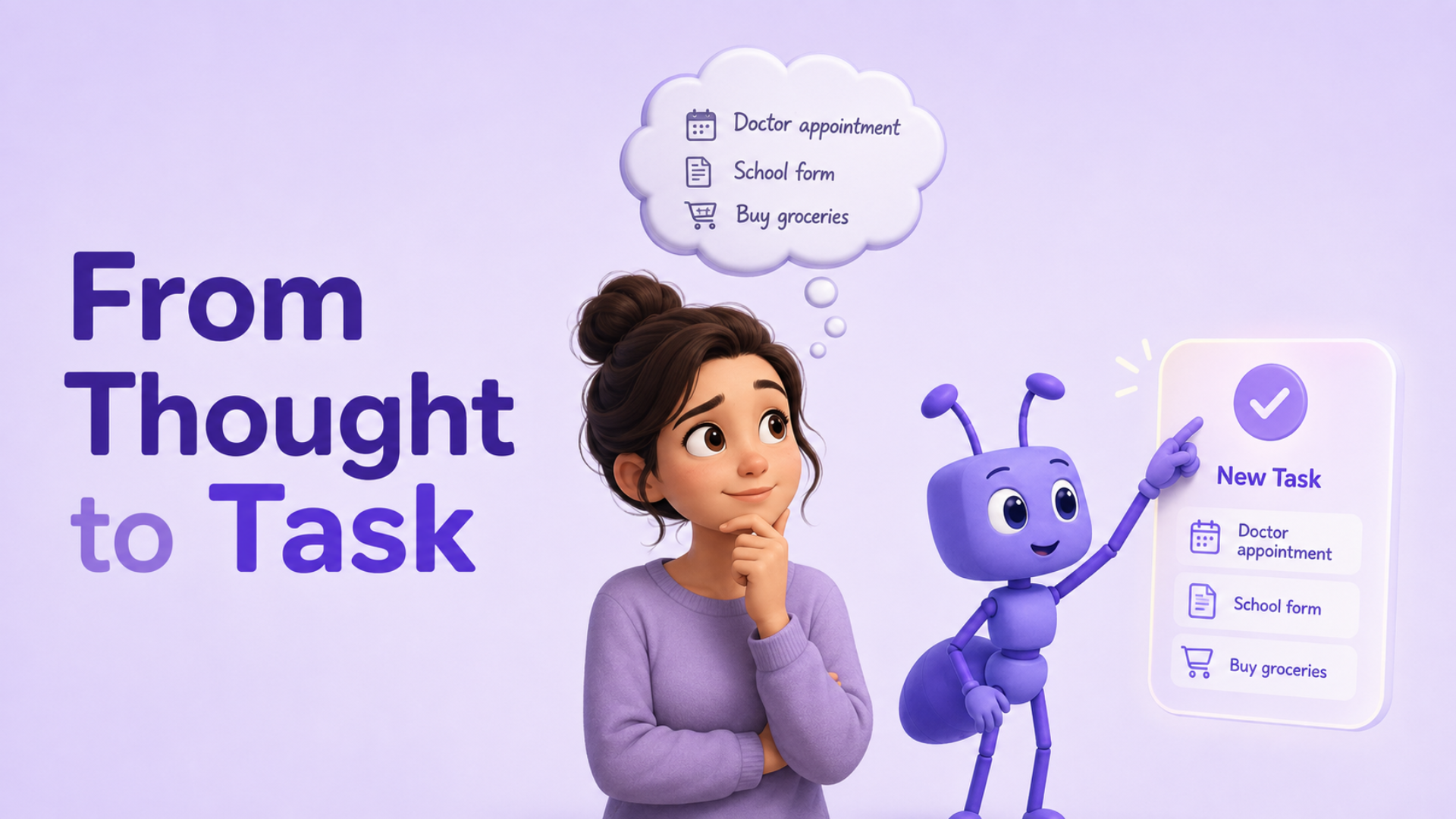
    Famant operates in three steps. First, you capture a thought the moment it occurs using voice, text, or photo. Then, Liv, the companion inside Famant, automatically organises the information by categorising the details, setting reminders, and assigning tasks to the appropriate family member. Finally, it syncs with that person’s view, keeping the entire household coordinated without the need for group chats.

    With these three steps, the mental load no longer falls on just one person. Let’s explore each step in detail.

    Step 1: Capture: Quickly Get Your Thoughts Out of Your Mind

    Good intentions don’t fail because of laziness but because of obstacles. Opening an app, finding the right list, typing a task, setting a date that’s five steps between a passing thought and saving it. When your hands are full, five steps are too many.

    Famant eliminates these steps. You capture a thought, however, life allows at that moment:

    • Speak it. Remember mid-drive that the car needs servicing? Just say it aloud.
    • Type it. Jot down a quick note in a few seconds — no formatting needed.
    • Snap it. Receive a paper notice from school? Take a photo, and you’re done.

    No need to choose categories or fill out fields. The goal is simply to move the thought out of your head and into a safe place within the two seconds you actually have, not later at a desk you might never return to.

    Step 2: Liv listens, understands, and suggests

    Capturing a thought is only half the challenge. A voice note or photo isn’t yet a task. Usually, someone has to read it, interpret it, decide when it matters, and determine who should take care of it. This invisible sorting is where mental effort really builds up.

    That’s Liv’s role. After you capture something, Liv reads it and organises it for you, extracting key details, figuring out timing, and assigning it to the right person. A photo of a school letter becomes a scheduled event with a reminder. A muttered “we’re low on diapers” turns into a task for the next shopping trip.

    You don’t have to sit down and enter data or build lists. The thought goes in raw and comes out organised, meaning the person who noticed the issue doesn’t have to be the one who processes it.

    Step 3: Sync: The Right Person Automatically Knows

    This is where most family systems quietly fail: even after something is recorded, someone still has to inform everyone else. That’s how households get overwhelmed with group chats where reminders get lost among jokes, weekend plans, and half-read messages.

    Famant removes that step. Once Liv organizes a task, it syncs directly to the appropriate family member’s view. If it’s your partner’s turn to pick up the kids, it appears to them. If it’s a shared deadline, everyone sees it. No one needs to be chased, reminded, or have messages forwarded; they can simply check and see what’s theirs.

    The result is a household that stays coordinated without anyone acting as a coordinator. Information reaches the right people automatically, instead of relying on one person’s memory and willingness to keep everyone informed.

    How This Works in Practice

    Imagine your daughter brings home a permission slip for a school trip that needs to be signed by Friday, along with a £12 payment.

    Usually, the slip ends up on the kitchen table. You intend to sign it, but forget about the payment. By Thursday night, someone is rushing to find cash and a pen, hoping it’s not too late.

    With Famant, the process is different:

    • You take a photo of the slip as soon as you receive it.
    • Liv reads the details, identifies the Friday deadline and the £12 payment, and creates two clear, dated reminders, one to sign the form and one to make the payment.
    • Both reminders appear in the family’s shared view and are already assigned to the responsible person, so whoever is handling it that week sees them immediately. No need for reminder texts or asking, “Did you take care of the slip?”

    A glance at the slip turns into a signed permission form and a paid trip without anyone having to keep track of the details all week.

    Become Part of the Families Who Understand

    The families who feel most at ease aren’t those doing the most. They’re the ones who’ve stopped relying on a single person’s memory for everything.

    Famant transforms fleeting thoughts, the ones that come when your hands are full and disappear before bedtime, into shared tasks that everyone in the household can see and handle together. Capture them as they happen. Let Liv organise them. Let it reach the right person, gently, on its own. Because a home shouldn’t depend on one person remembering everything. It should function as a team.

    Family life, a little lighter.

    Ready to ease the burden? Join the families who understand and try Famant today.

  • Shared Calendar vs. Family Organiser App: What’s Actually Different?

    Shared Calendar vs. Family Organiser App: What’s Actually Different?

    You can share a calendar in just five minutes. However, distributing the mental workload requires something that a calendar was never designed to handle.

    It begins with good intentions. You set up a shared calendar, invite everyone, and birthdays, appointments, and school events all appear in one organized, color-coded place. For a week or two, it feels like you’ve finally figured out how to stay organized.

    Then reality sets in. The permission slip remains unsigned. The dog food runs out. One partner assumes the other has taken care of groceries. A school email gets lost among numerous notifications. Eventually, someone says, “You never told me.”

    Here’s the odd part: the information was available all along, right there on the shared calendar. So why did things still fall through the cracks?

    Because a calendar only shows when something is scheduled. Managing a household requires much more than just remembering dates.

    What’s the difference between a shared calendar and a family organiser  app?

    A shared calendar informs your family about when events occur. A family organization app goes further — it helps everyone understand what tasks need to be done, who is responsible, and how daily household duties are managed. It combines schedules, tasks, reminders, notes, documents, and shared responsibilities in one place, making family life easier to coordinate without relying on one person to remember everything.

    It boils down to one question: is your household just tracking dates, or is it managing life?

    What a shared calendar does well

    Let’s give calendars their due credit. They solve one key problem better than most tools: visibility. Everyone can see when soccer practice starts, when Grandma’s birthday is, and which weekends are already booked. Reminders are set, events are color-coded, and scheduling conflicts are avoided.

    Popular tools like Google Calendar and Apple Calendar are widely used for good reasons. If your family only needed to keep track of appointments and events, you wouldn’t need anything else.

    But families usually don’t struggle because they forgot a birthday. They struggle because life involves hundreds of small responsibilities that never get added to the calendar in the first place.

    When a Shared Calendar Isn’t Enough

    Consider all the little things that keep a household functioning. Someone notices the milk is nearly finished. Someone else remembers the school project deadline is Tuesday, the insurance renewal is coming up next month, and there are only two dishwasher tablets left. Someone realizes the recycling needs to be taken out tonight.

    Most of these tasks don’t fit neatly on a calendar  yet they make up the mental burden of managing a home. Calendars weren’t designed to answer the most important questions:

    • Who is responsible for this?
    • Has it already been done?
    • Is anyone overwhelmed this week?
    • What still needs attention?

    As a result, one person often ends up carrying all this information mentally, creating events, setting reminders, assigning tasks, and following up to ensure nothing is missed. The calendar quietly becomes just another thing to manage instead of truly easing the workload. Read the complete guide to understanding the mental load

    How a Family Organiser App Helps

    A family Organiser  app is built on a different understanding: homes don’t run solely on schedules. They rely on communication, coordination, and shared responsibility.

    Importantly, it fits into real life where information rarely comes as a neat, pre-organized task. For example, with Famant, you don’t need to organize your thoughts before capturing them:

    • Remember mid-drive that the washing machine needs servicing? Just say it aloud.
    • Receive a paper notice from school? Snap a photo.
    • Need to keep track of an insurance renewal? Type a quick note.

    Famant captures details as they arise and files them appropriately. This means fewer sticky notes, fewer missed messages, and fewer reminders running through your mind all day. All the everyday coordination a calendar wasn’t made to handle.

    The Key Difference: Making Hidden Work Visible

    The most important change isn’t really about technology , it’s about visibility.

    In many households, one person quietly becomes the family’s memory. They know what’s in the fridge, keep track of appointments, remember birthdays, and remind everyone else. The problem is that this work is invisible to others, so it never gets shared.

    A family Organiser app makes this hidden work visible. Everyone can see what’s going on, what still needs to be done, and who is responsible. Instead of repeatedly asking “What should I do?”, family members can simply check the app.

    This shift turns delegation into shared ownership and that’s often where the greatest relief comes from. A shared calendar shows everyone’s schedules but can’t reveal if one person is silently managing everything behind the scenes. Sharing the planning and thinking that happens before the chores is what truly balances a household not by adding more tasks, but by distributing the invisible workload more fairly.

    Shared Calendar vs. Family Organization App, Side by Side

    Here’s how the two compare — not on features for their own sake, but on how much each one takes off your plate.

    What it doesShared CalendarFamant
    Shows appointments and events
    Keeps the family schedule in one place
    Tracks everyday household tasksLimited
    Assigns clear ownership, so nothing falls between people
    Makes the invisible mental load visible
    Helps balance responsibilities across the family

    A calendar tells you when. A family organization app makes sure no single person is the only one who knows.

    A Home Shouldn’t Rely on Just One Person to Remember Everything

    No family plans to become disorganized—life simply gets hectic. The real difficulty isn’t just recalling one important date; it’s managing the countless small details that quietly accumulate every week.

    If you’ve ever thought, “I thought someone else was taking care of that,” or noticed that one person always seems to remember everything, you’re not alone. Starting with a shared calendar is helpful. But if you want to go beyond just tracking dates and truly share the mental effort of running a household, it might be time for a solution designed for how families really live.

    Famant helps everyone stay coordinated by capturing those little details before they slip away, making responsibilities clear, and encouraging the whole family to contribute. Because a home shouldn’t depend on one person’s memory—it should be a team effort.

    Ready to lighten the load instead of carrying it alone? Try Famant.