Tag: Family Organiser App

  • The Holiday Mental Load: Why the Planner Never Switches Off

    The Holiday Mental Load: Why the Planner Never Switches Off

    Planning a trip doesn’t end when it starts. The person who researched, booked and packed is often still the one who knows where the tickets are, what’s next on the itinerary, and who’s watching the kids at the pool while everyone else actually switches off. A real holiday means someone else picks up that thread too, not just the suitcase.

    Day four. Someone asks what time dinner’s booked. Then whether they need swimming things tomorrow. Then where the sun cream ended up. Nobody’s being difficult they’re relaxed, which is precisely the point of being here. It’s just obvious to everyone, including you, who gets asked.

    You booked this. You compared the flights, worked out which area was walkable, checked whether the apartment had a lift, packed for people old enough to pack for themselves. And now you’re finally here, sitting by the pool, running through tomorrow’s transfer time in your head.

    Here’s the thing nobody mentions about the mental load: it doesn’t stay at home. It gets on the plane with you, and once you land it usually gets heavier.

    Why doesn’t the load stop when the holiday starts?

    Because the person who planned the trip is the only person who knows the plan.

    Everyone else arrives with no context at all which is a kind of luxury, and mostly an innocent one. They don’t know the museum shuts at four, that the second night’s dinner is booked and the third isn’t, or that the return transfer needs confirming the day before. So every question routes to you. Not because anyone decided it should, but because you’re the only one carrying the information.

    That’s how the trip’s organiser quietly becomes its rep. You’re not on holiday with your family so much as running one for them: fielding questions, keeping the schedule moving, doing the small continuous maths of what happens next. And the cruel bit is that it comes from caring. You did the research because you wanted it to be good. That care is exactly what makes you the obvious person to keep it running once you’re there.

    When does a holiday actually begin — and end?

    Long before the airport, and well after you’re home.

    Before. The packing for people who aren’t packing for themselves the children’s clothes, the sun cream, the medicines, the adapters, the snacks for the flight. Then the whole second job of shutting a house down: pausing the post, sorting the pets, emptying the fridge, telling the neighbour, handing over at work, digging out the passports and checking not one of them expires in the next six months.

    After. The suitcases in the hall, the mountain of washing, an empty fridge, and someone needing a clean uniform by Monday. Holidays are famous for the joy in the middle; the invisible work is concentrated at both ends, and it’s the same person at both.

    Why is it harder abroad than at home?

    Because at home, most of it runs on autopilot and abroad, nothing does.

    A normal week has structure holding it up. Everyone knows roughly where things live, what time school starts, which day the bins go out. Take that away and every single decision becomes fresh: where do we eat, how do we get there, is that a safe place to swim, where’s the nearest pharmacy, do we need cash for this. It looks like relaxation, but the person making those calls is working a full shift of small decisions in the sun.

    Then there’s the watching. In an unfamiliar place, near water, near traffic, someone’s attention is permanently half-on the children, and it’s rarely split evenly. That vigilance is the least visible work of the whole trip, and probably the most tiring, because it never stops long enough for you to notice you’re doing it. It sits right at the meeting point of the practical and the emotional, which is its own subject entirely. Read the complete guide to understanding the mental load

    How do you actually get a holiday too?

    Mostly by deciding, before you go, that the plan doesn’t belong to one person once you land.

    1. Split it in two: one plans, the other runs it. This is the single most effective change. Whoever books the trip hands the whole thing over on arrival — from the airport onwards, someone else holds the itinerary, answers the questions and gets everyone out of the door. The planning was already a job; the running of it shouldn’t go to the same person by default.
    2. Put the documents where everyone can reach them. Boarding passes, booking confirmations, insurance, passport photos. The moment those live in one person’s phone, that person is on duty for the entire week.
    3. Make the itinerary visible. If everyone can see what’s happening tomorrow, nobody has to ask — and asking is what keeps one person in the middle of it all.
    4. Put the pool watch on a rota, out loud. Actual shifts, actually named: you’ve got until three, then it’s me. Vague shared vigilance always collapses into one person doing it continuously.
    5. Let everyone pack for themselves. Anyone old enough gets their own list and their own bag. It’ll be imperfect. That’s fine a forgotten t-shirt on holiday is a very cheap lesson.
    6. Book the day back. One clear day at home before work restarts, for the washing and the shop, shared out in advance. Otherwise the trip ends with one person unpacking everyone’s life at 10pm on a Sunday.

    You might expect the planner to resist some of this a lot of people do, because they can already picture it being done differently. Which is worth naming: handing it over means letting someone reach the same place by a route you wouldn’t have chosen. That discomfort is the whole game, really, and it’s the thing worth getting good at.

    Making the trip run on more than one memory

    Most of this comes down to a simple problem: the information lives in one head, so the questions land on one person.

    Famant is built to get it out of there. The Document vault keeps tickets, passports and booking confirmations somewhere the whole family can reach, so nobody has to find you first. The Shared calendar holds the itinerary, so tomorrow’s plan is something people can look at rather than ask about. Snap a booking confirmation with Photo scan, or say a thought out loud with Voice capture, and Liv files it where it belongs including in the fortnight beforehand, when half the trip gets organised in stolen moments.

    Care Points do the quieter part: recognising who researched the flights, who remembered the travel insurance, who’s been holding the plan together the work that never shows up in the photos. Not to compare anyone; simply so it’s visible enough to share out. See how Care Points work, or join the waitlist.

    The real test

    It isn’t who carried the bags, or who booked the best restaurant.

    It’s whether everyone came home rested or whether one person spent a week working a job nobody could see, and then unpacked the suitcases too. A holiday that only works because one person never quite switched off isn’t really a holiday for them. It’s a change of scenery with the same load in it. (If this pattern sounds familiar in December as well, Christmas runs on exactly the same fuel.)

    Family life, a little lighter.

  • Mental Load vs Emotional Labour: Understanding the Difference

    Mental Load vs Emotional Labour: Understanding the Difference

    The mental load is the invisible mental work of remembering, planning and organising household life. Emotional labour is the effort of managing feelings; comforting others, easing conflict and holding relationships together. They’re different, but they often overlap, leaving one person carrying both the practical and the emotional work that keeps a home running.

    Imagine this.

    One parent remembers the dentist appointment. Book it. Moves a work meeting to make room. Reminds everyone twice. Packs the insurance card.

    Then spends the whole appointment holding the hand of a frightened child.

    Was that the mental load? Or emotional labour?

    It was both layered so tightly together that most of us never stop to tell them apart. And although the two terms are often used interchangeably, they aren’t the same thing. Knowing where one ends and the other begins is one of the first steps toward a more balanced home and a slightly lighter one.

    What is the mental load?

    The mental load is the invisible work of remembering, planning and organising everything a home needs, the thinking that happens long before any task gets done.

    It’s the running list in one person’s head: the permission slip due Friday, the milk that’s nearly out, the overdue car service, the birthday coming up in three weeks. None of it is physically hard. What’s exhausting is that it never switches off, and that it’s almost impossible for anyone else to see. Read our complete guide to the mental load

    What is emotional labour?

    Emotional labour is the work of managing feelings, your own and everyone else’s  to keep relationships steady and everyone feeling looked after.

    It’s the quieter, warmer counterpart to the mental load, and it shows up everywhere:

    • Keeping the peace when tempers are fraying
    • Remembering a friend’s had a hard week, and checking in
    • Supporting a stressed partner without being asked
    • Helping children name and settle big feelings
    • Phoning ageing parents so they don’t feel forgotten

    The term comes from sociologist Arlie Hochschild, who described how some jobs demand managing emotions as part of the work. It’s since become shorthand for all the unseen emotional effort that holds a family together, too.

    What’s the biggest difference?

    The simplest way to hold the difference: the mental load is about logistics; emotional labour is about feelings.

    One keeps the household running; the other keeps the household close. The mental load makes sure the dentist appointment happens. Emotional labour makes sure the frightened child feels safe once they’re in the chair. Both are real work. Both are largely invisible. And both tend to land on the same person.

    Mental loadEmotional labour
    PlanningComforting
    RememberingEncouraging
    OrganisingListening
    SchedulingManaging conflict
    Tracking tasksSupporting emotions

    Why do both usually fall on the same person?

    They tend to fall on the same person because the two kinds of work are deeply connected and because both are so easy to overlook.

    Whoever tracks the logistics is usually the one who notices the feelings, too: you can’t remember the dentist appointment without also sensing which child will be anxious about it. Over time, one person quietly becomes what’s often called the “default parent,” or the household manager, the one everyone turns to, and the one holding the whole picture in their head.

    None of this happens because anyone else is unwilling. It happens because the work is invisible. You can’t share or even offer to help with a load that no one else can see, so it settles, by default, on whoever noticed it first. What looks like a fair split on the surface can hide one person carrying almost all of the thinking underneath.

    How can families share both?

    You share both by making them visible first and then handing over whole areas of responsibility, not just individual jobs.

    A few things help:

    • Communication — naming the invisible work out loud, so it stops being a mystery only one person can solve
    • Ownership — taking on a whole area (“I’ve got all things school”), rather than waiting to be asked task by task
    • Visibility — keeping the load somewhere everyone can see it, instead of in one person’s memory
    • Regular planning — a short, calm catch-up so nothing quietly piles back onto one person
    • Appreciation — noticing and valuing the effort, especially the parts that never used to be seen

    The shift that matters most is from delegation to ownership: not “tell me what to do,” but “I’ve got this part.” Delegation still leaves one person noticing and asking. Ownership finally shares the weight.

    How Famant supports fairer family life

    Famant is built for the first half of that problem: the mental load. It makes the planning, reminders and everyday coordination visible to everyone, so the logistics of running a home stop resting on one person’s memory.

    Through Care Points, it also gives the invisible effort its due, recognising not just who completed a task, but who remembered it, planned it and kept everyone informed. Liv notices the thinking behind the doing and makes it visible, so a family gains a clearer picture of how care is really shared, and where more support is needed. More on how that works

    Famant can’t do the emotional labour for you that no app can. But by lifting the mental load and making quiet effort seen, it frees up the time, energy and goodwill that the emotional work depends on. It isn’t a scoreboard; it’s a kinder, shared view of how a home is really held together.

    The first step isn’t doing more

    You can’t fairly share work that nobody can see.

    So the first step isn’t doing more .  It’s making the invisible visible. Once both the logistics and the feelings are out in the open, a family can carry them together, instead of leaving them to rest on one person.

    Family life, a little lighter.

  • How Famant Works: Turning a Passing Thought Into a Shared Task

    How Famant Works: Turning a Passing Thought Into a Shared Task

    It always shows up at the most inconvenient time.

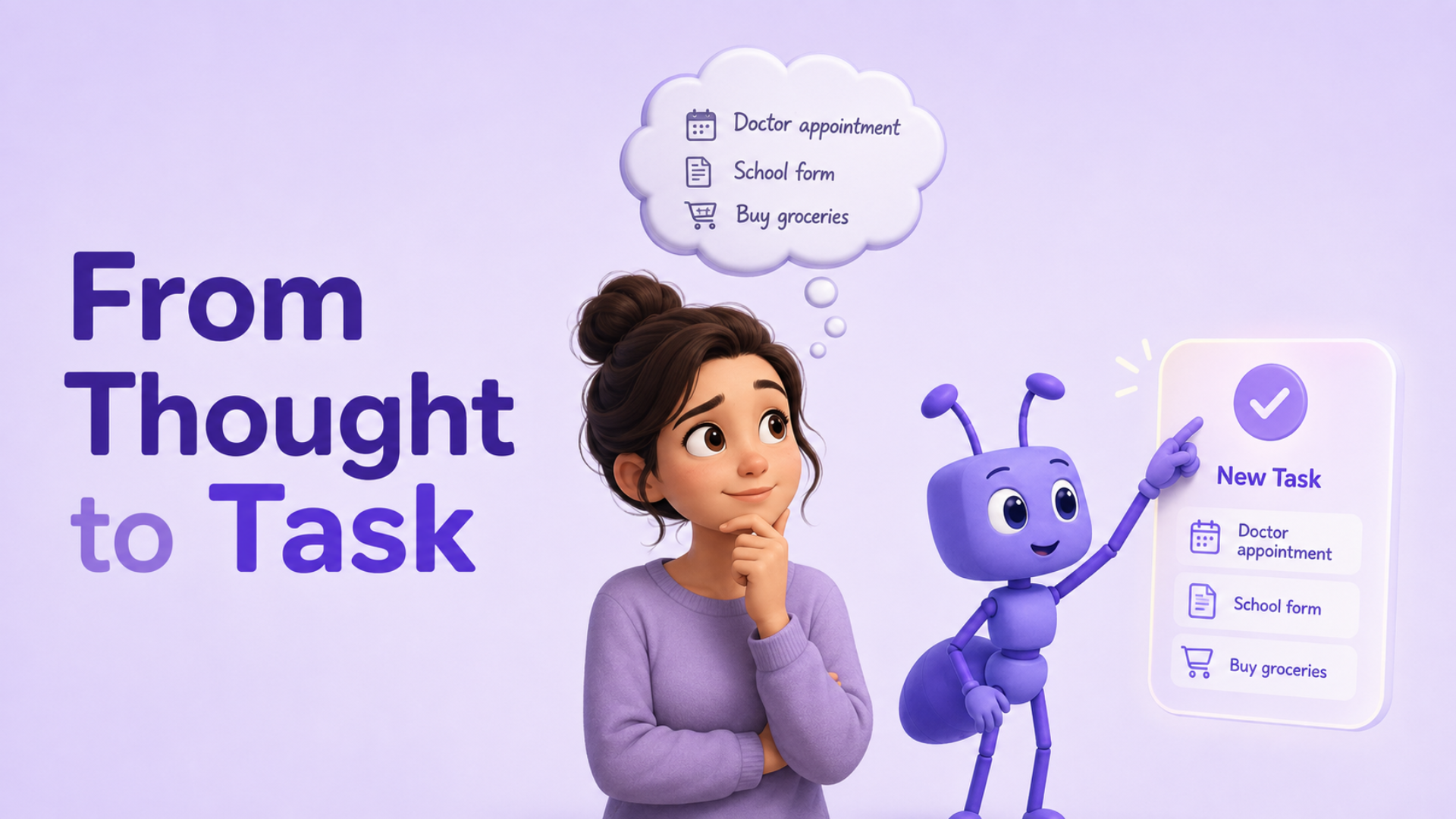
    With one hand stirring dinner and the other wiping the counter, a thought suddenly pops into your mind: the kids need a dental checkup. You plan to handle it later, but later never seems to come. By bedtime, the thought disappears, buried beneath homework, spilled juice, and the early start the next day. It will come back in a few weeks, usually when it’s least convenient.

    This fleeting thought is a small but important detail that appears when your hands are full and fades before you can act on it. When these moments add up over a week, they create the quiet fatigue of managing a household not from doing too much, but from having to remember too much.

    Famant is designed to capture these thoughts before they slip away. Here’s how it works.

    How Does Famant Work?

    Famant operates in three steps. First, you capture a thought the moment it occurs using voice, text, or photo. Then, Liv, the companion inside Famant, automatically organises the information by categorising the details, setting reminders, and assigning tasks to the appropriate family member. Finally, it syncs with that person’s view, keeping the entire household coordinated without the need for group chats.

    With these three steps, the mental load no longer falls on just one person. Let’s explore each step in detail.

    Step 1: Capture: Quickly Get Your Thoughts Out of Your Mind

    Good intentions don’t fail because of laziness but because of obstacles. Opening an app, finding the right list, typing a task, setting a date that’s five steps between a passing thought and saving it. When your hands are full, five steps are too many.

    Famant eliminates these steps. You capture a thought, however, life allows at that moment:

    • Speak it. Remember mid-drive that the car needs servicing? Just say it aloud.
    • Type it. Jot down a quick note in a few seconds — no formatting needed.
    • Snap it. Receive a paper notice from school? Take a photo, and you’re done.

    No need to choose categories or fill out fields. The goal is simply to move the thought out of your head and into a safe place within the two seconds you actually have, not later at a desk you might never return to.

    Step 2: Liv listens, understands, and suggests

    Capturing a thought is only half the challenge. A voice note or photo isn’t yet a task. Usually, someone has to read it, interpret it, decide when it matters, and determine who should take care of it. This invisible sorting is where mental effort really builds up.

    That’s Liv’s role. After you capture something, Liv reads it and organises it for you, extracting key details, figuring out timing, and assigning it to the right person. A photo of a school letter becomes a scheduled event with a reminder. A muttered “we’re low on diapers” turns into a task for the next shopping trip.

    You don’t have to sit down and enter data or build lists. The thought goes in raw and comes out organised, meaning the person who noticed the issue doesn’t have to be the one who processes it.

    Step 3: Sync: The Right Person Automatically Knows

    This is where most family systems quietly fail: even after something is recorded, someone still has to inform everyone else. That’s how households get overwhelmed with group chats where reminders get lost among jokes, weekend plans, and half-read messages.

    Famant removes that step. Once Liv organizes a task, it syncs directly to the appropriate family member’s view. If it’s your partner’s turn to pick up the kids, it appears to them. If it’s a shared deadline, everyone sees it. No one needs to be chased, reminded, or have messages forwarded; they can simply check and see what’s theirs.

    The result is a household that stays coordinated without anyone acting as a coordinator. Information reaches the right people automatically, instead of relying on one person’s memory and willingness to keep everyone informed.

    How This Works in Practice

    Imagine your daughter brings home a permission slip for a school trip that needs to be signed by Friday, along with a £12 payment.

    Usually, the slip ends up on the kitchen table. You intend to sign it, but forget about the payment. By Thursday night, someone is rushing to find cash and a pen, hoping it’s not too late.

    With Famant, the process is different:

    • You take a photo of the slip as soon as you receive it.
    • Liv reads the details, identifies the Friday deadline and the £12 payment, and creates two clear, dated reminders, one to sign the form and one to make the payment.
    • Both reminders appear in the family’s shared view and are already assigned to the responsible person, so whoever is handling it that week sees them immediately. No need for reminder texts or asking, “Did you take care of the slip?”

    A glance at the slip turns into a signed permission form and a paid trip without anyone having to keep track of the details all week.

    Become Part of the Families Who Understand

    The families who feel most at ease aren’t those doing the most. They’re the ones who’ve stopped relying on a single person’s memory for everything.

    Famant transforms fleeting thoughts, the ones that come when your hands are full and disappear before bedtime, into shared tasks that everyone in the household can see and handle together. Capture them as they happen. Let Liv organise them. Let it reach the right person, gently, on its own. Because a home shouldn’t depend on one person remembering everything. It should function as a team.

    Family life, a little lighter.

    Ready to ease the burden? Join the families who understand and try Famant today.

  • Shared Calendar vs. Family Organiser App: What’s Actually Different?

    Shared Calendar vs. Family Organiser App: What’s Actually Different?

    You can share a calendar in just five minutes. However, distributing the mental workload requires something that a calendar was never designed to handle.

    It begins with good intentions. You set up a shared calendar, invite everyone, and birthdays, appointments, and school events all appear in one organized, color-coded place. For a week or two, it feels like you’ve finally figured out how to stay organized.

    Then reality sets in. The permission slip remains unsigned. The dog food runs out. One partner assumes the other has taken care of groceries. A school email gets lost among numerous notifications. Eventually, someone says, “You never told me.”

    Here’s the odd part: the information was available all along, right there on the shared calendar. So why did things still fall through the cracks?

    Because a calendar only shows when something is scheduled. Managing a household requires much more than just remembering dates.

    What’s the difference between a shared calendar and a family organiser  app?

    A shared calendar informs your family about when events occur. A family organization app goes further — it helps everyone understand what tasks need to be done, who is responsible, and how daily household duties are managed. It combines schedules, tasks, reminders, notes, documents, and shared responsibilities in one place, making family life easier to coordinate without relying on one person to remember everything.

    It boils down to one question: is your household just tracking dates, or is it managing life?

    What a shared calendar does well

    Let’s give calendars their due credit. They solve one key problem better than most tools: visibility. Everyone can see when soccer practice starts, when Grandma’s birthday is, and which weekends are already booked. Reminders are set, events are color-coded, and scheduling conflicts are avoided.

    Popular tools like Google Calendar and Apple Calendar are widely used for good reasons. If your family only needed to keep track of appointments and events, you wouldn’t need anything else.

    But families usually don’t struggle because they forgot a birthday. They struggle because life involves hundreds of small responsibilities that never get added to the calendar in the first place.

    When a Shared Calendar Isn’t Enough

    Consider all the little things that keep a household functioning. Someone notices the milk is nearly finished. Someone else remembers the school project deadline is Tuesday, the insurance renewal is coming up next month, and there are only two dishwasher tablets left. Someone realizes the recycling needs to be taken out tonight.

    Most of these tasks don’t fit neatly on a calendar  yet they make up the mental burden of managing a home. Calendars weren’t designed to answer the most important questions:

    • Who is responsible for this?
    • Has it already been done?
    • Is anyone overwhelmed this week?
    • What still needs attention?

    As a result, one person often ends up carrying all this information mentally, creating events, setting reminders, assigning tasks, and following up to ensure nothing is missed. The calendar quietly becomes just another thing to manage instead of truly easing the workload. Read the complete guide to understanding the mental load

    How a Family Organiser App Helps

    A family Organiser  app is built on a different understanding: homes don’t run solely on schedules. They rely on communication, coordination, and shared responsibility.

    Importantly, it fits into real life where information rarely comes as a neat, pre-organized task. For example, with Famant, you don’t need to organize your thoughts before capturing them:

    • Remember mid-drive that the washing machine needs servicing? Just say it aloud.
    • Receive a paper notice from school? Snap a photo.
    • Need to keep track of an insurance renewal? Type a quick note.

    Famant captures details as they arise and files them appropriately. This means fewer sticky notes, fewer missed messages, and fewer reminders running through your mind all day. All the everyday coordination a calendar wasn’t made to handle.

    The Key Difference: Making Hidden Work Visible

    The most important change isn’t really about technology , it’s about visibility.

    In many households, one person quietly becomes the family’s memory. They know what’s in the fridge, keep track of appointments, remember birthdays, and remind everyone else. The problem is that this work is invisible to others, so it never gets shared.

    A family Organiser app makes this hidden work visible. Everyone can see what’s going on, what still needs to be done, and who is responsible. Instead of repeatedly asking “What should I do?”, family members can simply check the app.

    This shift turns delegation into shared ownership and that’s often where the greatest relief comes from. A shared calendar shows everyone’s schedules but can’t reveal if one person is silently managing everything behind the scenes. Sharing the planning and thinking that happens before the chores is what truly balances a household not by adding more tasks, but by distributing the invisible workload more fairly.

    Shared Calendar vs. Family Organization App, Side by Side

    Here’s how the two compare — not on features for their own sake, but on how much each one takes off your plate.

    What it doesShared CalendarFamant
    Shows appointments and events
    Keeps the family schedule in one place
    Tracks everyday household tasksLimited
    Assigns clear ownership, so nothing falls between people
    Makes the invisible mental load visible
    Helps balance responsibilities across the family

    A calendar tells you when. A family organization app makes sure no single person is the only one who knows.

    A Home Shouldn’t Rely on Just One Person to Remember Everything

    No family plans to become disorganized—life simply gets hectic. The real difficulty isn’t just recalling one important date; it’s managing the countless small details that quietly accumulate every week.

    If you’ve ever thought, “I thought someone else was taking care of that,” or noticed that one person always seems to remember everything, you’re not alone. Starting with a shared calendar is helpful. But if you want to go beyond just tracking dates and truly share the mental effort of running a household, it might be time for a solution designed for how families really live.

    Famant helps everyone stay coordinated by capturing those little details before they slip away, making responsibilities clear, and encouraging the whole family to contribute. Because a home shouldn’t depend on one person’s memory—it should be a team effort.

    Ready to lighten the load instead of carrying it alone? Try Famant.