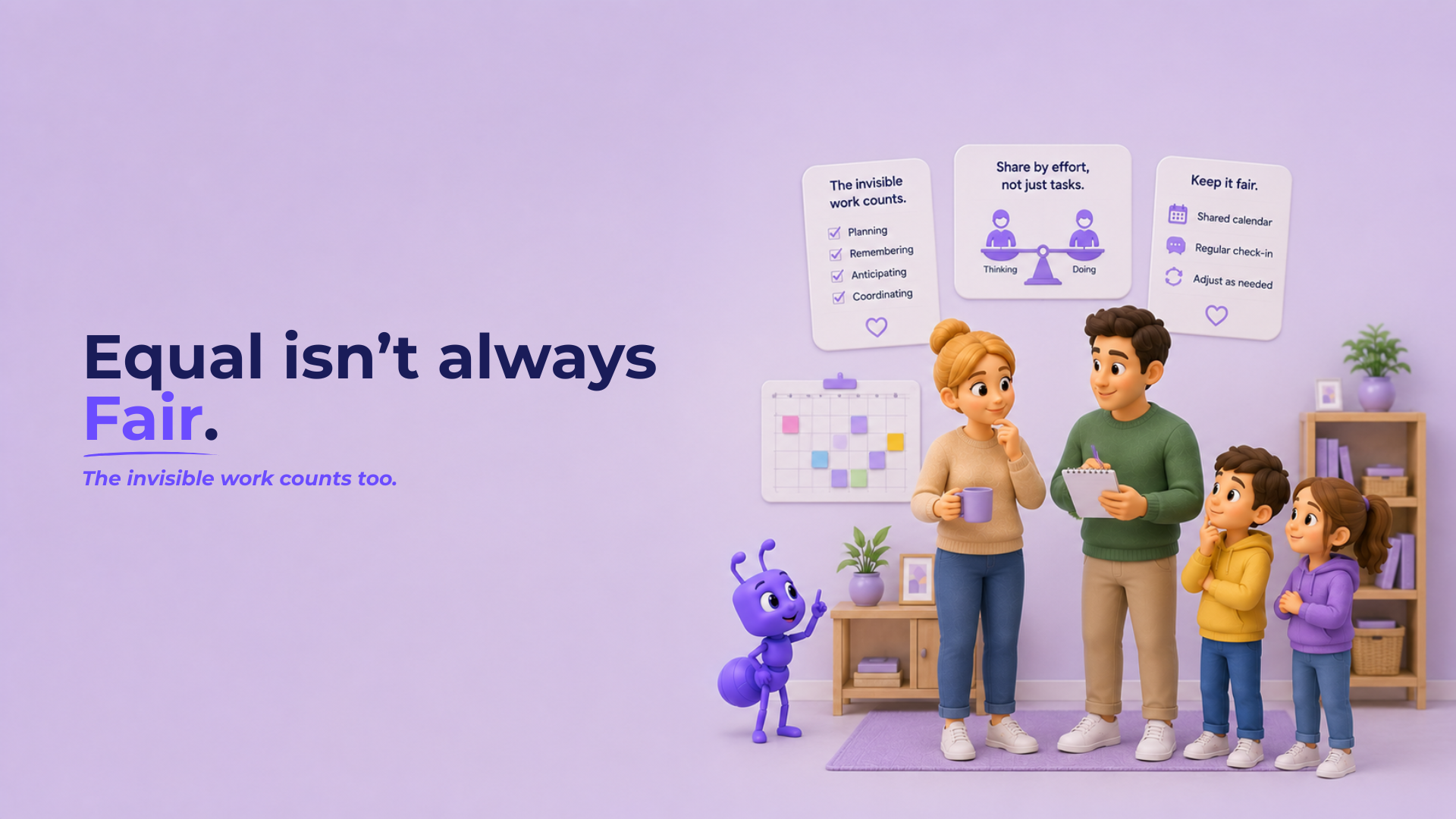
A home can look completely equal, with both partners working, the chores divided, everyone pulling their weight and still be deeply unequal underneath. The reason is that the invisible work of planning, remembering, and managing a household rarely gets counted.
And here’s the part that surprises people: this gap persists even in the most equal-minded societies. In fact, the more equality a culture expects, the more sharply the remaining imbalance is felt.
Closing it doesn’t mean trying harder at the chores. It means making the invisible work visible and dividing it on purpose, by real effort, rather than by who happens to notice it first.
If you believe in an equal partnership and still feel the load isn’t shared, you’re not imagining it. You’re noticing something real.
What is the equality paradox?
It’s the gap between equal on paper and equal in practice.
Two partners can both work full-time, split the visible tasks evenly, and sincerely consider themselves equal while one of them still carries nearly all of the mental load. The planning, the remembering, the anticipating: the management layer of the household tends to sit with one person, even in homes that look balanced from the outside.
This isn’t a failure of good intentions. It’s that the invisible work has never been named, so it’s never been divided. You can’t share what no one has acknowledged is there.
The chores get split because chores are visible. The thinking stays put because thinking isn’t.
Why do more equal cultures feel the gap more, not less?
Because expectations rise faster than habits change.
In places where equality is a genuine, stated value backed by generous family policy, shared parental leave, and the assumption that both parents work people are raised to expect a fair partnership. And when you expect fairness, you’re far less willing to quietly accept its absence.
The research bears this out: in cultures where equality is part of the social and political fabric, both partners are less tolerant of an uneven division at home, not more.
So the lingering imbalance doesn’t feel like the natural order of things, the way it might have a generation ago. It feels like a contradiction a home that’s supposed to be equal and somehow still isn’t.
That discomfort isn’t a sign of ingratitude. It’s a sign that the values have moved ahead of the daily reality, and the home hasn’t caught up yet.
What does “fair” actually mean once you count the invisible work?
Fair isn’t splitting every task fifty-fifty. It’s sharing the whole load — including the thinking so that no one person is left managing the household on top of doing their half of it.
Here’s why a task-by-task split misses the point. Imagine a couple who divide the chores perfectly: one cooks, the other cleans; one does laundry, the other handles the shopping. It looks like the model of fairness.
But if only one of them is tracking what needs buying, noticing what’s run low, remembering the appointments, and deciding what happens when then one person is doing their half and running the entire operation. The visible work is even. The real load is not.
True fairness counts the invisible work as work. It treats remembering and planning as labour worth dividing because it is. Read the complete guide to understanding the mental load
How do you make the invisible work visible?
You write it down all of it. This is the step that changes everything, and it’s simpler than it sounds.
Sit down together and list everything it takes to run your home. Not just the chores, but the planning and tracking behind them: who remembers the birthdays, who notices the supplies, who books the appointments, who holds the schedule in their head.
Most couples find the list is far longer than they expected and that an uncomfortable amount of it has been resting on one person. Not by anyone’s choice, but by drift.
Then divide it by effort and by whole areas, rather than by individual tasks. Give one person true ownership of a domain its noticing, its remembering, its doing instead of one person managing everything and handing out jobs.
Ownership shares the load. Delegation just moves a task while leaving the management exactly where it was.
How do you keep it fair?
By accepting that fairness drifts, and building something to hold it in place.
Even a well-shared load tends to creep back toward one person over time, simply because old habits are strong and the person who used to track everything finds it hard to stop.
So the systems matter: a shared calendar everyone uses, a single shared view of what’s coming, a regular check-in to catch things sliding back out of balance. Fairness isn’t a conversation you have once. It’s something you maintain lightly, but on purpose.
Why is this worth the effort?
Because an unfair load doesn’t just wear one person out it slowly erodes the relationship itself.
When one partner is permanently the manager and the other the helper, the dynamic stops feeling like a partnership. Resentment grows in the gap where appreciation should be.
The research consistently links an uneven division of household labour to lower relationship satisfaction and greater strain between partners and, just as consistently, links a fairer share to stronger, steadier relationships.
So this was never really about chores. It’s about whether two people who believe in an equal partnership actually get to live in one.
The good news is that you already hold the value. The only thing left is to close the gap between what you believe and how your home runs and that begins the moment the invisible work stops being invisible.
Leave a Reply