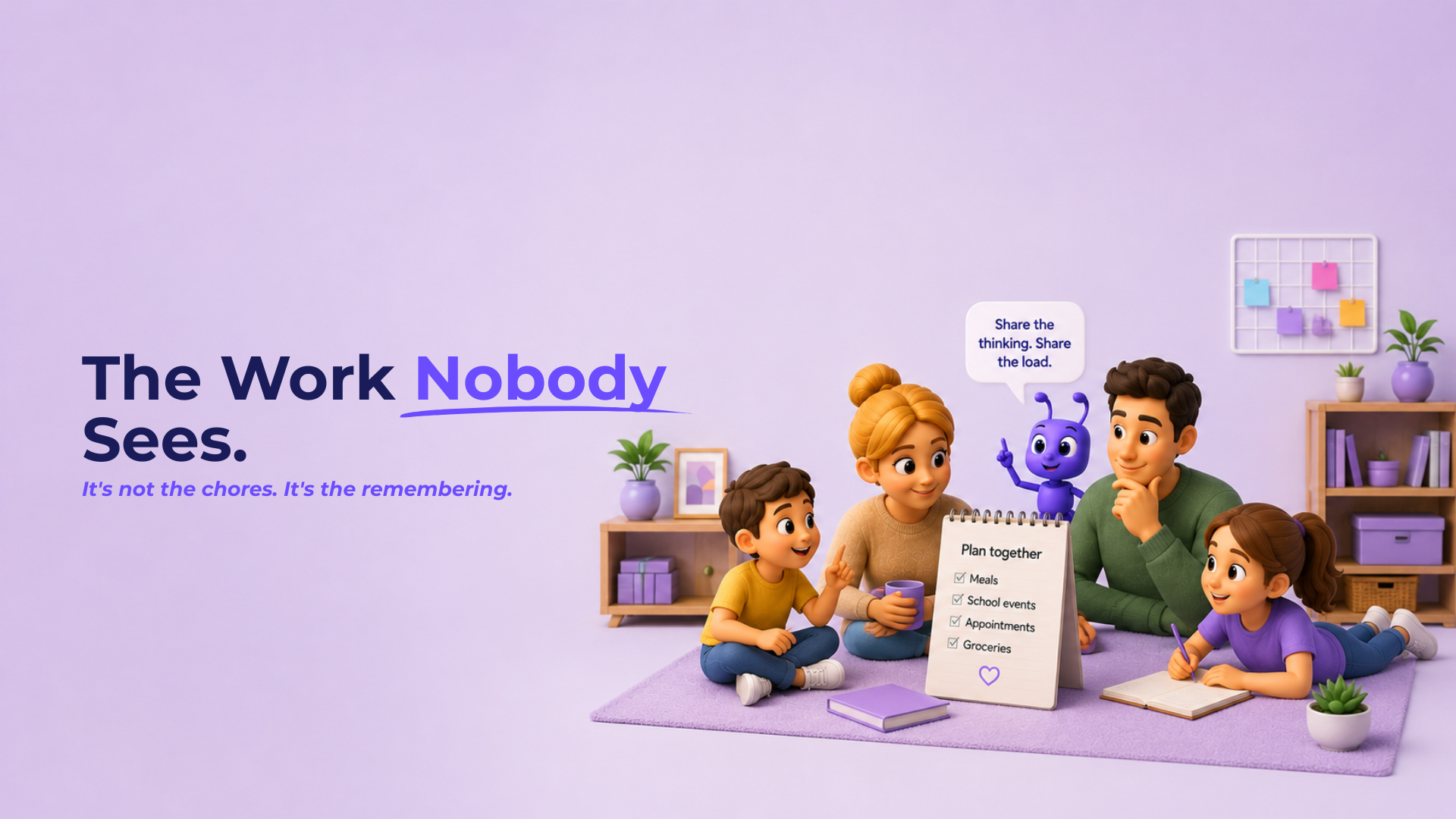
The mental load is the invisible, never-ending work of running a household: remembering, planning, anticipating, and coordinating everything a family needs before anyone else notices it’s needed. It isn’t the cooking or the cleaning. It’s knowing the fridge is nearly empty, that a permission slip is due Friday, that the youngest has outgrown their shoes, and that someone has to book the dentist before the year fills up.
You can divide the visible chores perfectly evenly and still leave one person doing all the remembering. And because that work is invisible and never finished, it quietly settles onto one person until it becomes one of the biggest hidden sources of stress in a home.
If you’ve ever felt drained by a day where you “didn’t really do anything,” you’ve felt it. Here’s what the mental load is, why it falls the way it does, and how to start sharing it.
What does the mental load actually mean?
It’s the management layer of family life ,the thinking, not the doing.
The doing is visible: someone packs the bag, someone cooks the meal. The thinking is invisible: someone had to know the bag needed packing, what went in it, and when it had to be ready.
Picture it this way. In most homes, one person has quietly become the project manager. They hold the master list in their head, notice what’s running low, anticipate what’s coming, and assign the tasks often to themselves.
The other person may help a great deal. But they help when asked. The gap between running the household and helping with it is the whole of the mental load and it almost never shows up in a fair-looking division of chores.
Why isn’t splitting the chores enough?
Because chores are the smallest part of the work. The bigger part is everything that has to happen before a chore even becomes a chore.
Take “doing the food shopping.” It looks like one task. In reality it’s noticing what’s run out, tracking what everyone will eat this week, remembering the birthday on Saturday, building the list, knowing the budget and only then the actual shopping.
A couple can agree that one person “does the shopping” and still leave all the invisible planning on someone else’s plate. Usually the same person, every week.
That’s why so many couples who feel they’ve divided things fairly still have one partner stretched thin. The tasks are shared. The thinking isn’t.
Why does it land on one person?
Partly habit, partly a dynamic that builds without anyone choosing it.
Once one person becomes the keeper of the master list, it’s genuinely easier in the short term for them to keep holding it than to explain it. Asking someone to do a task often takes more effort than just doing it yourself. So the person who already carries the load keeps absorbing more of it.
Over months and years, one person becomes the family’s memory, and the other becomes someone who waits to be told.
There’s a generational layer, too. Many couples today grew up expecting an equal partnership and genuinely believe they have one. That belief is good but it can make the imbalance harder to see, because it doesn’t fit the story the couple tells about themselves.
In dual-income homes, where both partners work full days, the invisible management still tends to skew to one of them. And the gap between we’re equal and why am I the only one who remembers anything can be quietly disorienting.
What does the mental load have to do with burnout?
A great deal. The mental load is cognitive work that never switches off.
The brain doesn’t get to clock out from a list that’s always running in the background the appointments, the supplies, the social calendar, the small worries about whether everyone has what they need. That constant low-level vigilance is exhausting in a way that’s hard to point to, precisely because there’s nothing visible to show for it.
Carried long enough, it’s a real contributor to burnout. It also quietly strains relationships: the person carrying the load starts to feel less like a partner and more like a manager, and resentment grows where appreciation should be.
None of it is dramatic. It’s the slow accumulation of always being the one who remembers.
Signs you might be carrying more than your share
You may be holding most of the mental load if a few of these feel familiar:
- You notice when things are running low, long before anyone else.
- If you stopped tracking something, it simply wouldn’t get done.
- You feel you have to ask your partner to help, rather than sharing the load by default.
- You can’t fully relax even when the visible work is done, because the list in your head is still running.
- You feel tired in a way that doesn’t match what you “actually did” that day.
None of this means your partner doesn’t care. It usually means the invisible work has never been made visible so it’s never been shared.
How do you start sharing it?
The first move isn’t a new chore chart. It’s making the invisible work visible. You can’t fairly divide something that lives in one person’s head and nowhere else.
Write it all down not just the tasks, but the thinking behind them. Everything that has to be remembered, planned, tracked, and decided. Most couples are surprised by how long the list is, and how much has been resting on one person without either of them choosing it.
Then share the planning, not just the doing. Real change comes when both partners own whole areas including the noticing and remembering rather than one person delegating individual tasks.
“You’re in charge of everything to do with the children’s health” shares the load. “Can you book the dentist?” just borrows a hand for a moment and leaves the management where it was.
Finally, build systems that don’t depend on one person’s memory. A shared calendar everyone actually uses. A single place the whole family can see what’s coming. A habit of capturing things the moment they come up, so they leave your head and become something everyone can see.
The goal isn’t a perfectly optimised household. It’s a home where no single person has to hold it all together alone.
Because the mental load was never really about chores. It’s about who carries the weight of a family running smoothly and whether that weight is finally shared.
If this is something you’re navigating in your own home, the most useful first step is simply to make the invisible work visible together and to talk about it openly, before it turns into resentment.
Leave a Reply